

Written by Gowtham Raj, Director at TartLabs.
What Should AI Agents Do in a CI/CD Pipeline in 2027?
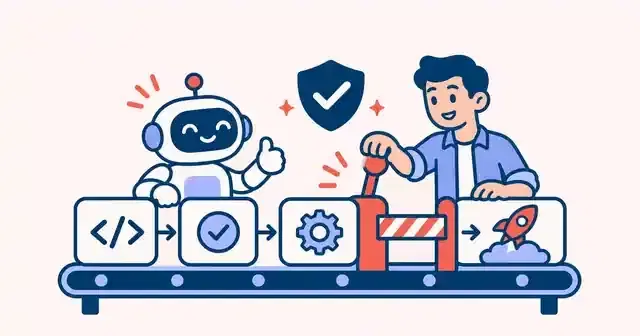
Let agents read, summarize, and propose. Keep humans in charge of anything that ships code to production, changes permissions, or touches secrets. In practice that means automating issue triage, CI failure analysis, test writing, documentation updates, and dependency pull requests, while a person approves production deploys, merges to protected branches, and infrastructure or access changes. This guide gives you the split, the evidence behind it, and a staged rollout for 2027. It is written for engineering leads, DevOps owners, and CTOs deciding how much autonomy to give agents in the delivery pipeline.
Key Takeaways
- AI now generates or significantly assists an average of 65% of the code developers commit, and 76% say they generate AI code faster than they can verify it (Sonar, 2027 State of Code Developer Survey, November 12, 2026, 1,026 respondents)
- Only 39% completely agree AI code is always checked before it is committed, down from 48% a year earlier, while 94% do not fully trust it (Sonar, 2027 State of Code analysis)
- In a 2026 academic test on live GitHub Actions workflows, every one of four AI providers was susceptible to at least one high-severity prompt-injection attack (GitInject, arXiv, 2026)
- GitHub Agentic Workflows went generally available on October 28, 2026 with read-only permissions by default and writes routed through "safe outputs" (GitHub Changelog)
- Our rule of thumb: automate steps where a wrong answer is cheap and reversible, and keep a human on steps where it is neither
Why Is This Decision Urgent Heading Into 2027?
Agents are already inside pipelines, and verification has not kept pace. Sonar's 2027 survey found that 5% of respondents are building or using autonomous "software factories" today and 34% expect to within a year (Sonar, 2027 State of Code Developer Survey, November 2026). Meanwhile 53% now spend more time reviewing code than creating it, compared with 18% who say that was true before they adopted AI tools. The same survey reports that 76% say their teams use AI coding tools for business-critical or mission-critical services, up from 58% the year before.
The platform side moved too. GitHub's agentic workflows let you describe automation in plain Markdown and run a coding agent inside GitHub Actions for tasks such as issue triage, CI failure analysis, documentation updates, and test writing (GitHub Changelog, October 2026). The technical preview opened in February 2026, so teams have had roughly nine months of this pattern becoming normal.
Two caveats apply. This is a vendor survey, and Sonar sells code verification tooling, so read the direction of the numbers more than the exact percentages. It is also self-reported attitudes, not measured defect or outage rates. Even so, the pattern is consistent: more code, less checking, higher stakes.
What Is Safe to Automate With an Agent?
Automate work where the agent produces a proposal or a summary that a person or a deterministic check reviews, and where a mistake costs minutes rather than an outage. This is our recommendation, not a published standard, and it follows the principle GitHub's own security write-up describes: stage and vet all writes, and log everything (GitHub Blog, Under the hood, March 2026).
| Pipeline task | Agent role | Why it is safe enough | Guardrail to keep |
|---|---|---|---|
| Issue and PR triage | Label, deduplicate, route | Output is a label or comment | Read-only token, write only via a scoped comment or label action |
| CI failure analysis | Read logs, explain the likely cause | Advisory text only | Redact secrets from logs before the agent sees them |
| Test writing | Draft tests for new code | Tests are reviewed like any code | Agent opens a PR, never pushes to a protected branch |
| Documentation and changelog updates | Draft from merged changes | Low blast radius | Human skims before merge |
| Dependency update PRs | Propose bumps, summarize release notes | Existing tests gate the PR | Pinned versions, no auto-merge on major versions |
| Flaky-test detection | Flag and cluster repeat failures | Read-only analysis | Quarantine decisions stay with the owning team |
Our take: The best first agent is boring. A triage or CI-failure-summary agent with a read-only token teaches your team how agents behave in your pipeline, and it can do only limited damage while you learn, provided logs are redacted first. Starting with an auto-deploying agent skips that learning stage, and in our view it raises the cost of every early mistake.
Five Steps That Stay Human in 2027
Keep a person on every step that is hard to reverse, that widens access, or that decides whether code reaches customers. These are the five we would not hand over in 2027:
- Production deploy approval. An agent can prepare the release notes and the diff summary. A named person clicks approve.
- Merge to protected branches. Agent-authored code goes through the same review as human-authored code. Sonar's survey is a warning here: only 39% completely agree AI code is always checked, so do not rely on informal habit. Enforce it with branch protection and a written AI agent governance policy.
- Secrets, IAM, and workflow permission changes. An agent that can edit its own permissions or its own workflow file can widen its own reach. Treat changes to
.github/workflows/, cloud roles, and secret stores as human-only. - Infrastructure changes that destroy or move state. Database migrations, network rules, and anything with a data-loss path need a human and a rollback plan.
- Incident calls with customer impact. An agent can gather logs and draft a timeline. Deciding to roll back, fail over, or notify customers is a human judgment.
Rollback itself is a useful exception: a deterministic rule such as "roll back if the error rate crosses a set threshold" is automation, not agency, and it removes a judgment call from a stressful moment. Keep that logic in plain, testable code rather than in an agent's judgment.
Why Is Prompt Injection a Pipeline Risk, Not Just a Chatbot Risk?
An agent in CI reads text that attackers can write, such as issue titles, PR descriptions, comments, and branch names, while holding credentials that can change your code. That combination is new. A static workflow follows fixed logic. An agent can be steered by instructions hidden in the same text it is supposed to read.
The evidence from 2026 is concrete:
- GitInject (arXiv, submitted June 2026, revised November 2026). Researchers ran eleven named attack scenarios against five workflows from four AI providers on live GitHub Actions, and report that every provider was susceptible to at least one high-severity attack in the tested configurations. The most serious flaws were structural: configuration files from an unmerged contribution were loaded as operator-level instructions (GitInject, arXiv:2606.09935).
- Cloud Security Alliance research note (May 3, 2026). It describes a "Comment and Control" attack class documented in April 2026, in which a malicious PR comment or issue can instruct coding agents to leak API keys and the
GITHUB_TOKENinto public Actions logs with no action from a maintainer beyond the automated trigger (CSA, Prompt Injection in AI-Powered GitHub Actions).
The CSA note's immediate fixes are practical and not specific to one vendor: pin third-party Actions to full commit SHAs, remove pull_request_target workflows that check out fork code, use OIDC-based short-lived cloud credentials, and give every workflow a minimum-privilege permissions block. We would add one rule of our own: no agent should see a secret it does not strictly need, and none should run on content from an untrusted fork without human approval first.
Platform Guardrails Narrow the Blast Radius, Not the Responsibility
They narrow the blast radius. They do not make an agent trustworthy. GitHub's Agentic Workflows, generally available since October 28, 2026, run agents with read-only permissions by default inside a sandboxed container behind a firewall, validate outputs through a "safe outputs" step, and run a threat-detection job on proposed changes before they are applied (GitHub Changelog). That is the right shape: stage the write, vet it, then apply it.
Still, three gaps remain for your team to own. First, a guardrail only helps if you use it, so audit every workflow for broad tokens and unpinned dependencies. Second, a platform cannot decide which of your steps are reversible; that is the table above. Third, you need evidence. Sonar's 2027 survey found only 36% say their team measures AI's productivity impact and can see the results. Log what each agent read, proposed, and changed, so a review after an incident takes minutes. Our guide to AI agent governance, audit trails and guardrails covers the logging side in more depth.
A Four-Stage Rollout for 2027
Move in four stages, and promote an agent to the next stage only after a review of what it actually did. No 2027 benchmark exists yet for how fast teams should progress, so treat the stage lengths as a starting point you tune.
- Read-only observers (first month). Triage, log summaries, and flaky-test reports. No write access at all.
- Proposers (months two to three). Agents open PRs for tests, docs, and dependency bumps. Branch protection requires human review.
- Gated actors (after a clean review of stage two logs). Agents run approved, narrow actions through safe-output style gates, such as applying a label or opening a ticket, with every action logged.
- Revisit autonomy per step, not per agent. Promote a specific step only when a quarter of logs shows no surprises. Production deploys and permission changes stay human.
Sonar's survey also reports that teams giving coding agents clear standards and controls are more likely to report an ROI of 50% or more than teams with few controls. That is a correlation from a vendor survey, but it matches what the staged approach is designed to produce: speed with a safety net. If this rollout is one piece of a wider AI roadmap, our AI strategy for software companies pillar shows how pipeline automation fits with the rest, and our overview of DevOps tools worth knowing covers the pipeline basics the agents sit on top of.
The Bottom Line
For 2027, use agents as fast, tireless readers and proposers in your pipeline, and keep people on the steps that ship code, widen access, or touch secrets. The evidence points the same way from two directions: verification is lagging behind generation, and prompt injection is a demonstrated way to turn a helpful agent against your own repository. Start read-only, promote one step at a time, and log everything.
To map your own pipeline into automate-now and keep-human steps, contact TartLabs and we will review it with you. For the wider plan around it, see our AI strategy for software companies guide.