AI-Generated Code and Technical Debt: What the 2026 Data Shows
AI coding tools speed delivery but studies show more duplication, less refactoring and weaker stability. What the 2026 data says and how to contain the debt.
By Tart Labs·Published
Want to start a Project?
share
share
Written by Gowtham Raj, Director at TartLabs, who works with engineering teams on AI development and software product delivery. TartLabs builds AI-assisted software for clients, so we see these review and debt trade-offs in live projects.
The Short Answer
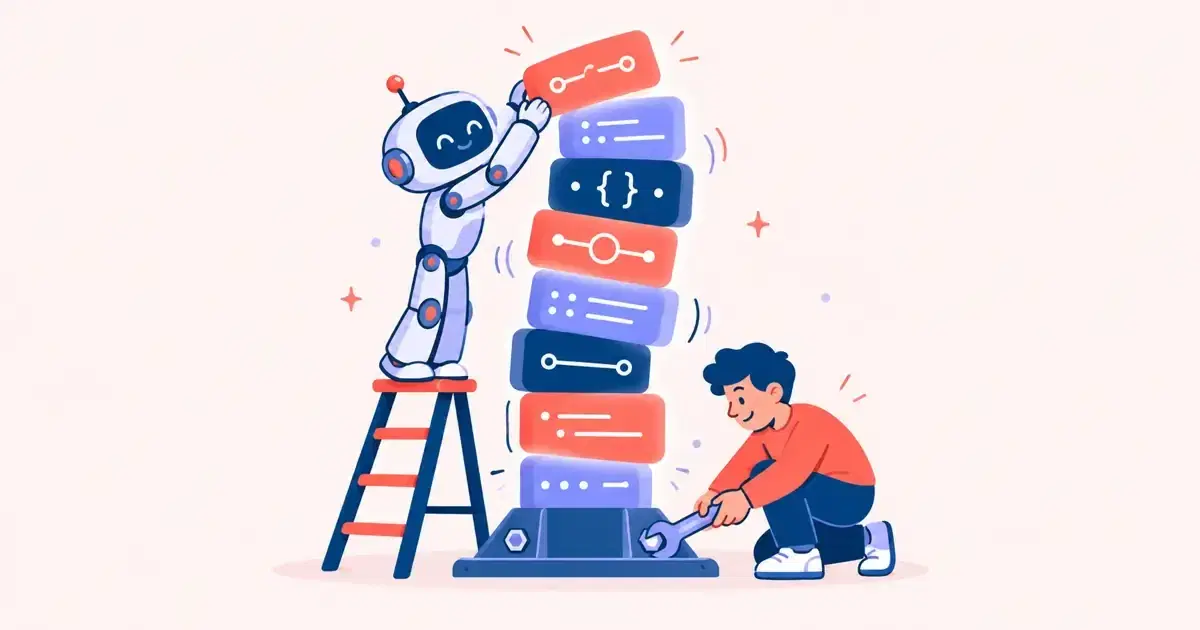
AI coding tools make teams faster, and the 2026 data says they also add technical debt: more duplicated code, less refactoring, and more change instability. The debt is not inevitable. It grows where review, testing and architecture were already weak, and it shrinks where teams treat AI output as a draft that someone is accountable for.
The studies on this topic measure different things, so no single number settles it. Below: what the strongest sources found, where the evidence is thin, and what a team can do this quarter.
Key Takeaways
Duplication is rising and refactoring is falling. GitClear's analysis of 623 million code changes, as reported by LeadDev, found duplicated code up 81% against pre-AI levels and moved (refactored) code down 70%.
Developers see the debt too. In Sonar's January 2026 survey of over 1,100 developers, 88% reported negative effects of AI on technical debt, and 93% also reported positive ones.
Speed and stability have split. The 2025 DORA report found AI adoption now relates positively to throughput but still negatively to delivery stability.
Quality gaps show up in review data.CodeRabbit's December 2025 study of 470 pull requests found about 1.7 times more issues per AI-co-authored PR, though the vendor sells review tools and the sample is small.
Controls decide the outcome. DORA's authors attribute the instability to higher change volume overwhelming weak testing and feedback loops, which is fixable.
What Counts as Technical Debt in AI-Generated Code
Technical debt is the future cost of a shortcut taken today. With AI-generated code the shortcut is rarely a hack. It is code that works, passes a quick check, and turns out harder to maintain than it should be.
Three patterns recur across the sources below:
Duplication. The assistant writes a new block instead of reusing an existing function, because it only sees part of the codebase.
Frequently Asked Questions (FAQ)
It can. GitClear's analysis of 623 million code changes, as reported by LeadDev, found duplicated code up 81% and refactoring down 70% against pre-AI levels, and 88% of developers in Sonar's 2026 survey reported negative effects of AI on technical debt. The same survey found 93% reporting benefits, so the outcome depends on how the code is reviewed and tested.
Let's connect and create something amazing together!
Got an idea or project in mind? Whether it's custom software, a dedicated dev team, or help with digital transformation, we're here for it. Reach out—we'll bring your vision to life.
Contact us
Prefer to speak directly? You’ll find our address, email, and contact details right here.
Office Location
Block A1 Third Floor, Rathinam TechZone, SEZ Campus Pollachi Main Road, Eachanari, Coimbatore, Tamil Nadu 641021, India
Thinking through a new idea or stuck with a challenge? Drop us a message—we'll listen, brainstorm, and help move things forward.
Skipped refactoring. Accepting a suggestion is a single keypress. Cleaning up the surrounding code takes deliberate effort, so it is done less often.
Plausible but unreliable logic. Code that looks right, compiles and fails on edge cases that nobody tested. Sonar's survey found 53% of developers name this as a negative effect.
What the 2026 Data Shows
Duplication up, refactoring down
GitClear's maintainability study, covering 623 million real-world code changes from 2023 to 2026, reports duplicated code up 81% against pre-AI levels, moved or refactored code down 70%, and changes to code older than 12 months down 74%, according to LeadDev's July 2026 coverage. GitClear's own report is at gitclear.com. We could not load it directly, so the figures here come from LeadDev's reporting of it.
An earlier GitClear study of 211 million changed lines reached the same direction. It found that blocks of five or more duplicated lines rose eightfold during 2024, and that 2024 was the first year copy-pasted lines outnumbered moved lines, per DevClass.
Developers say the debt is real, and so are the gains
Sonar's State of Code survey, published in January 2026 with over 1,100 developers, reports that AI-generated code makes up 42% of committed code. It also found that 96% do not fully trust AI-generated code to be functionally correct, and that only 48% always verify it before committing.
The technical debt findings cut both ways. 93% reported positive effects, such as better documentation (57%) and higher test coverage (53%). 88% reported negative effects, including code that looks correct but is not reliable (53%) and unnecessary or duplicated code (40%). Both can hold for the same team in the same week.
Faster delivery, less stable systems
The 2025 DORA report, built on responses from nearly 5,000 technology professionals, reached a more nuanced result than the previous year's. Its authors wrote that, unlike the year before, they saw a positive relationship between AI adoption and both delivery throughput and product performance. They also wrote that AI adoption continues to have a negative relationship with delivery stability.
DORA's explanation is practical. AI speeds up development, and that speed can expose weak spots downstream; without strong automated testing, mature version control and fast feedback loops, a higher volume of change leads to instability. Part of the debt problem is flow: more code arrives than the system can safely absorb.
Review data points the same way, with caveats
CodeRabbit's December 2025 report compared 320 AI-co-authored and 150 human-only open-source pull requests. It found 10.83 issues per AI-co-authored PR against 6.45 for human-only PRs, roughly 1.7 times as many, with logic and correctness issues up 75% and readability problems more than tripled. Treat this one carefully. The sample is small, authorship labeling was difficult, and CodeRabbit sells AI code review tooling.
The four sources side by side
Source
Sample
Key finding
Main caveat
GitClear (via LeadDev)
623M code changes, 2023-2026
Duplication +81%, moved code -70%
Secondary reporting, vendor study
Sonar State of Code
1,100+ developers, Jan 2026
88% report debt downsides, 93% report upsides
Self-reported, vendor survey
DORA 2025
Nearly 5,000 professionals
Throughput up, stability down
Correlation, not causation
CodeRabbit
470 pull requests, Dec 2025
About 1.7x more issues per PR
Small sample, vendor study
Where the Evidence Is Weaker
An honest read of this data has limits:
Most figures measure code patterns, not business outcomes. More duplication raises maintenance risk. None of these studies price what that costs a specific team.
AI is not the only cause. Delivery pressure, thin tests and unclear ownership create debt without any model involved.
Vendor-run studies have incentives. Sonar, GitClear and CodeRabbit all sell products that address code quality.
The consistent direction across sources with different methods matters more than any single percentage.
How to Contain AI-Generated Technical Debt
These steps map to the failure patterns above.
Make authors accountable for every AI-assisted diff
The person who commits the code owns it. Require authors to be able to explain the change line by line. Our guide on how to review AI-generated code covers a review process and a pull request template.
Put debt checks in the pipeline
Run duplication detection, static analysis and dependency checks before human review. Track a few trends over time: duplication rate, share of changes that are refactors, change failure rate and time to restore. If duplication climbs while refactors fall, your team is seeing the GitClear pattern.
Budget refactoring explicitly
Adding code is now cheap, so consolidating it needs protected time. Set aside a fixed share of each sprint for cleanup, and put "reuse an existing module" on the review checklist.
Give the assistant context
Duplication often comes from missing context. Point tools at your shared libraries, naming conventions and architectural decisions, and write down the standards they should follow. Our AI coding standards policy template is a starting point.
Strengthen the downstream controls first
DORA's finding suggests where to start: automated tests, small batch sizes and fast feedback. If those are weak, adding AI speed makes instability worse. If they are strong, the same tools deliver gains.
Decide your standard as part of a wider AI plan
Debt policy is one piece of how a software company adopts AI. Our AI strategy guide for software companies covers how coding standards, review and governance fit together.
A Quick Self-Check for Your Team
Do you measure duplication and refactoring rate, not just velocity?
Can every author explain their AI-assisted diff?
Are automated tests and static analysis blocking merges?
Is time for refactoring protected in the sprint?
Do assistants have access to your standards and shared libraries?
As a rough heuristic, if you answer "no" to two or more, debt is likely accumulating faster than you can see.
The Bottom Line
AI speeds up writing code and shifts the cost to maintaining it. Duplication is up, refactoring is down, and delivery stability lags throughput unless testing and review keep pace. Teams that measure those signals and fund cleanup keep the speed without the bill.
If you want help setting up AI-assisted delivery with the right guardrails, or a dedicated team that already works this way, talk to us. For the strategy view, see our AI strategy guide for software companies.
96% of developers don't fully trust AI code, yet only 48% always check it. A five-step review process, a checklist and a risk-tier table for your team.