Custom Healthcare AI Software Development: A Complete Guide
Learn how custom healthcare AI software can support patient care, automate routine work, improve healthcare services, and help organizations build secure and useful AI solutions.
By Tart Labs·Published
Want to start a Project?
share
share
Introduction
How can AI help healthcare providers deliver better care and simplify their daily tasks? As healthcare becomes more digital, artificial intelligence in healthcare helps hospitals, clinics, startups, insurers, and medical technology companies use data better, reduce manual work, and make faster decisions.
Each organization has its own workflows, patient data systems, business goals, and compliance needs. This is where custom healthcare AI software development can make a difference. It focuses on building AI-powered healthcare software around the specific needs of a healthcare business.
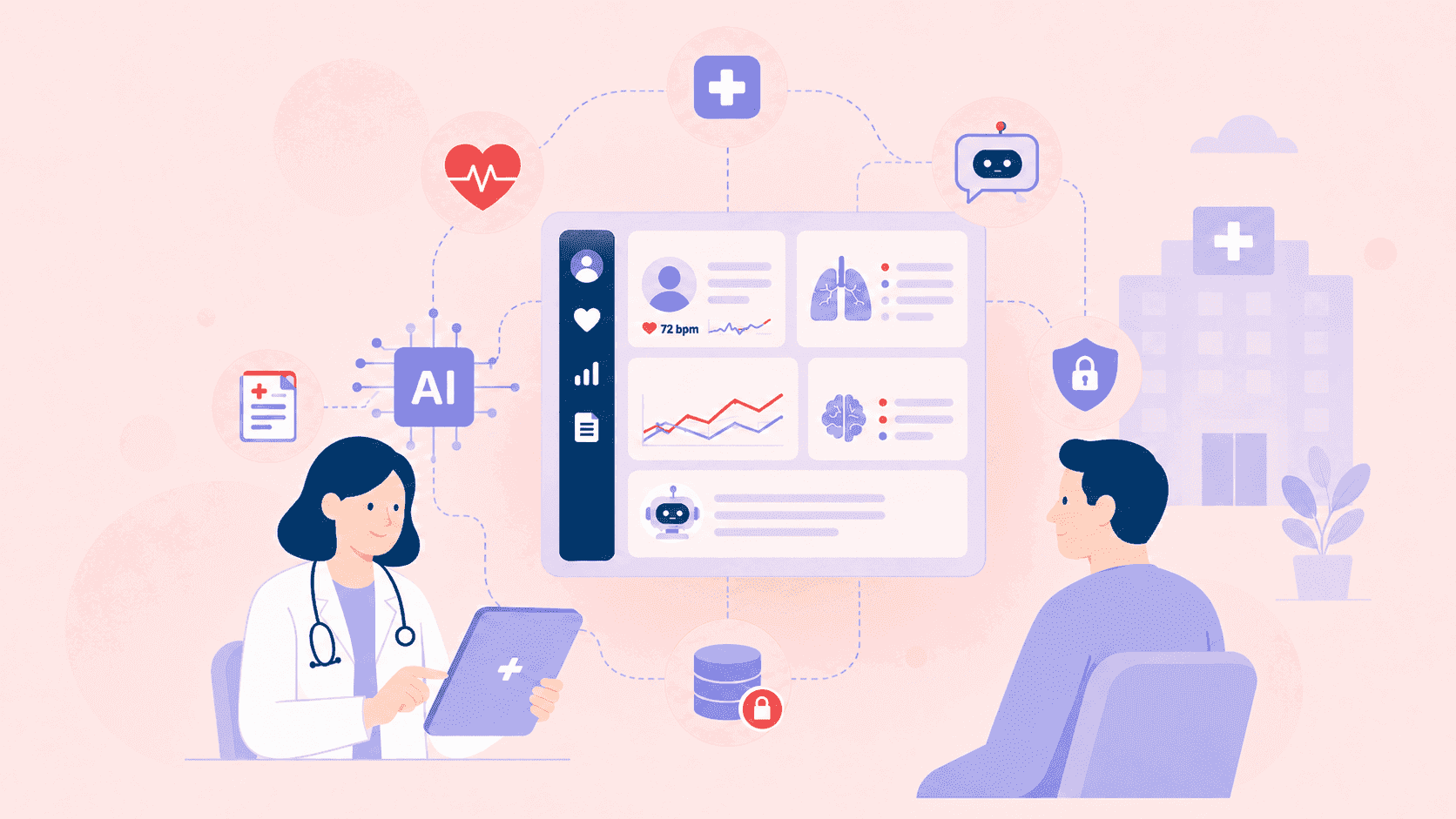
Today, healthcare AI solutions can support many areas, including clinical decision support, medical imaging, patient engagement, EHR automation, predictive analytics in healthcare, remote patient monitoring, and administrative tasks. Generative AI in healthcare, AI agents in healthcare, and machine learning in healthcare are also creating new ways to improve healthcare services.
With the right AI implementation in healthcare, organizations can improve daily operations, reduce costs, support better patient outcomes, and build systems that can grow with their needs. This guide covers healthcare AI use cases, key technologies, the development process, healthcare AI integration, EHR AI integration, development costs, and how to choose the right healthcare AI software development company.
What Is Custom Healthcare AI Software Development?
What if healthcare software could be built around the exact needs of a hospital, clinic, or healthcare business? Custom healthcare AI software development is the process of creating AI-powered software for specific healthcare needs instead of using a ready-made tool.
Healthcare AI software development can include tools for patient data management, medical diagnosis support, appointment handling, patient communication, health data analysis, and workflow automation. These systems can also connect with existing healthcare platforms through healthcare AI integration and EHR AI integration.
For example, a healthcare business use AI automation in healthcare to reduce repetitive tasks or use predictive analytics in healthcare to find possible patient risks earlier. AI healthcare app development can also help create mobile apps for patients, doctors, and care teams.
Why are more healthcare organizations looking at AI to improve their daily work and patient services? Custom AI solutions for healthcare can be built around the specific needs of hospitals, clinics, healthcare startups, and other medical businesses. Unlike general tools, these solutions can match existing workflows and systems.
Frequently Asked Questions (FAQ)
Custom healthcare AI software development means creating AI-based software for the specific needs of hospitals, clinics, healthcare startups, and other healthcare businesses. The software can include features such as patient support, data analysis, automation, and medical decision support.
Let's connect and create something amazing together!
Got an idea or project in mind? Whether it's custom software, a dedicated dev team, or help with digital transformation, we're here for it. Reach out—we'll bring your vision to life.
Twelve questions to put to any AI development partner, backed by RAND, Gartner and MIT findings on why AI projects fail and what good answers sound like.
Thinking through a new idea or stuck with a challenge? Drop us a message—we'll listen, brainstorm, and help move things forward.
Here are some key benefits of custom healthcare AI software development:
Improved Clinical Decision-Making
Doctors often review different patient details before deciding on the right care. AI-powered healthcare software can help organize patient data, find useful patterns, and provide relevant information when needed. This can support doctors in making more informed clinical decisions.
Faster Diagnosis and Treatment Planning
AI can review health data, medical images, and other patient information quickly. Machine learning in healthcare and AI development for healthcare can support doctors by pointing out possible health risks or unusual findings. This can help healthcare teams plan the next steps faster while keeping doctors involved in the final decision.
Reduced Administrative Workload
Healthcare teams often have to handle many routine activities, record updates, appointment handling, and document work. AI automation in healthcare can handle or support many of these routine tasks. This lets healthcare teams give more attention to patient care.
Better Patient Engagement
Patients expect simple and quick ways to communicate with healthcare providers. Healthcare AI solutions can support chatbots, virtual assistants, patient apps, reminders, and personalized communication. AI healthcare apps can give patients access to medical details, appointment services, and direct contact with care providers.
Top Use Cases of AI in Healthcare Software
How can AI help healthcare teams provide better care while making everyday tasks easier? Today, AI healthcare software development is being used in many areas, from helping doctors review patient information to reducing repetitive office work.
Clinical Decision Support Systems
Clinical decision support systems can help doctors and care teams review patient information, medical history, and test results. AI-powered healthcare software can highlight useful information and possible risks, helping healthcare professionals make better-informed decisions.
AI Medical Imaging and Diagnostics
AI can examine scans and other medical pictures to help doctors spot useful details. AI medical imaging and diagnostics can help identify patterns that need further review. This can support doctors and help speed up the diagnosis process.
Healthcare Chatbots and Virtual Assistants
Healthcare AI solutions can include chatbots and virtual assistants that answer common questions, share basic health information, send reminders, and help patients with appointments. These tools can improve communication and patient support.
Predictive Analytics for Patient Risk Management
Predictive analytics in healthcare uses patient information to identify possible health risks. Healthcare teams can use these insights to monitor high-risk patients and plan care more effectively.
AI-Powered EHR Automation
Keeping electronic health records updated can take up a large part of the healthcare team's daily work. EHR AI integration can help with tasks such as data entry, record summaries, and information retrieval. This healthcare team spends more time on patient-related duties.
Types of Custom Healthcare AI Solutions
What type of AI software is right for a healthcare organization? The answer depends on its goals, users, and daily needs. Custom AI solutions for healthcare can be built for different areas of healthcare, from patient communication to medical data analysis.
AI Healthcare Mobile Apps
AI healthcare mobile apps can help patients and care teams access healthcare services from their phones. These apps offer appointment booking, reminders, health tracking, basic AI support, and communication with healthcare providers. AI healthcare app development can be tailored to the needs of a specific healthcare business.
AI Telemedicine Platforms
AI can make telemedicine platforms more useful by supporting online consultations, patient information collection, appointment scheduling, and follow-up reminders. AI tools can help doctors review important health details before an online appointment.
AI Patient Portals
AI patient portals give patients a simple way to view health information, manage appointments, receive reminders, and communicate with healthcare providers. AI can also help patients find useful health details and respond to simple queries.
AI Diagnostic Software
AI diagnostic software can help doctors check scan reports, lab findings, and other details about a patient's health. These tools can find patterns and highlight information that need a doctor's attention. These tools work alongside doctors and do not take over their role.
AI Healthcare Analytics Platforms
AI healthcare analytics platforms help organizations understand large amounts of healthcare data. They can support reporting, patient risk tracking, predictive analytics in healthcare, and business decisions. These platforms can help healthcare organizations improve their services and use their data more effectively.
Core Technologies Used in Healthcare AI Development
What technologies help AI work in healthcare? Different AI tools are used to handle patient data, support doctors, improve patient services, and reduce repetitive work. The right technology depends on what the healthcare software needs to do.
Machine Learning
Machine learning in healthcare helps software learn from past data and find patterns. It can be used for patient risk checks, disease prediction, treatment support, and other healthcare AI use cases. It can also help healthcare teams get useful insights from existing data.
Natural Language Processing
Natural language processing, or NLP, helps computers understand written and spoken language. In healthcare, it can be used to read medical notes, organize patient records, power healthcare chatbots, and help staff find information from large amounts of text.
Generative AI and LLMs
Generative AI in healthcare can create new content such as summaries, responses, and notes based on the information it receives. LLMs can support patient questions, medical record summaries, and routine documentation. Human review is still important when AI is used for healthcare-related decisions.
Computer vision allows AI software to understand images. In healthcare, it can be used with X-rays, CT scans, MRI images, and other medical images to find patterns that need a doctor's attention. This makes it useful for AI medical imaging and diagnostics.
Predictive Analytics
Predictive analytics in healthcare uses existing data to find possible future risks or trends. It can help care teams identify patients who need closer attention, plan resources, and improve patient care.
Healthcare AI Software Development Process
How can a healthcare organization turn an AI idea into a useful and reliable software solution? A clear development process helps teams build software that meets healthcare needs, protects patient information, and works well with existing systems.
Step 1: Requirement Analysis and Use Case Discovery
Start by finding the main problem that the software should address.
Talk with doctors, nurses, staff, and other users.
Understand their daily tasks and common problems.
Decide where AI can save time or improve patient care.
Set clear goals and decide what the product needs to do.
Step 2: Data Preparation and AI Model Selection
AI needs suitable data to give useful results.
Collect the data needed for the project.
Check the data for missing or incorrect information.
Choose the right AI method based on the project.
Consider machine learning in healthcare, NLP, computer vision, or generative AI in healthcare where needed.
Step 3: UI/UX and Software Architecture Design
The software should be easy for healthcare users to understand and use.
Plan simple screens and user flows.
Design separate experiences for patients, doctors, and staff when needed.
Plan the database, APIs, AI services, and other parts.
Plan healthcare AI integration with existing systems such as EHRs.
Step 4: Development, Testing, and Validation
The team now builds and checks the software.
Develop the main software features.
Add and connect the required AI features.
Test the software for errors and security issues.
Check whether the AI gives useful and accurate results.
Test the system with real-world workflows before launch.
Step 5: Deployment, Monitoring, and Optimization
After testing,
Deploy the software in the required environment.
Monitor system performance and AI results.
Track errors and user feedback.
Fix problems and improve features when needed.
Update the AI model when new data or better methods are available.
HIPAA Compliance, Security, and Data Privacy
What steps can healthcare providers take to protect private health data when using AI? Security and privacy are very important when building healthcare AI software because these systems handle sensitive patient health information.
PHI Protection in AI Systems
PHI refers to private health details linked to a person, including their medical history, test results, and care records. HIPAA-compliant AI software should have proper safeguards to protect PHI and prevent unauthorized access or use.
Data Encryption and Access Control
Patient data should be protected when it is stored and when it is being sent between systems. Encryption can help keep data safe. Access controls should also make sure that only approved users can view or manage sensitive information.
Audit Trails and Activity Logs
Healthcare AI systems should keep records of important user and system activities. Audit trails and activity logs can show who accessed information, what action they took, and when it happened. This can help organizations find unusual activity and review security issues.
Secure AI Model and API Integration
AI models and APIs should be connected to healthcare systems in a secure way. Healthcare AI integration and EHR AI integration should use proper authentication, access controls, and secure data transfer methods.
Responsible AI Governance
AI should be used carefully and with clear rules. Healthcare organizations should review AI results, protect patient privacy, check for errors, and keep people involved in important healthcare decisions.
The cost depends on the type of solution, AI features, number of integrations, security needs, and the size of the healthcare organization.
Healthcare AI Solution
Estimated Cost (USD)
Typical Development Time
Healthcare AI MVP
$20,000 to $100,000
3 to 6 months
AI Healthcare Mobile App
$40,000 to $120,000
3 to 6 months
Custom EHR/EMR with AI Features
$100,000 to $300,000+
8 to 18 months
Mid-Level Healthcare AI Platform
$100,000 to $200,000
6 to 12 months
Enterprise Healthcare AI Platform
$200,000 to $500,000+
12 to 24+ months
How to Choose a Healthcare AI Software Development Company
Choosing the right healthcare AI software development company is important because healthcare applications handle sensitive patient information and need to work correctly. A good development partner should understand both healthcare and AI technology.
Healthcare Domain Expertise
Look for a company with a strong background in building healthcare software. They should understand how healthcare systems work, how patient information is handled, and what healthcare professionals need from an application.
A company with healthcare experience can better understand your requirements and build software that fits real-world healthcare workflows.
AI/ML Development Experience
The company should have experience developing AI and machine learning solutions for healthcare use cases. Check whether they have worked on features such as medical data analysis, predictive analytics, virtual assistants, recommendation systems, or automated reporting.
It is also useful to review their previous AI projects to understand the type of solutions they have built and how they handled real-world data.
HIPAA and Compliance Knowledge
Healthcare software must follow important rules for protecting patient information. If your application handles patient data in the United States, the development company should understand HIPAA requirements and follow proper security practices.
Check whether the provider uses strong security methods, limits who can view data, and protects patient records.
EHR, FHIR, and HL7 Integration Expertise
Many healthcare apps need to work with systems already used by healthcare providers, including EHR platforms. The development team should know how to use FHIR and HL7 for sharing healthcare data between different systems.
This experience can make it easier to connect your AI application with hospitals, clinics, laboratories, and other healthcare systems while allowing data to move safely between them.
Post-Launch Support and Maintenance
Healthcare AI software needs regular updates, monitoring, bug fixes, security improvements, and technical support after launch. AI models may also need updates when new data becomes available.
Before choosing a company, ask what support they provide after the application goes live. A reliable development partner should be available to fix issues, improve performance, update the software, and help the application grow as your needs change.
Conclusion
Have a healthcare AI idea or need help? Contact us today. TartLabs can understand your requirements, suggest the right approach, and help you plan your healthcare AI solution based on your goals, budget, and timeline.