Introduction
One of our AI engineers recently showed us how he completed a task that normally took nearly an hour in less than 10 minutes. Instead of manually opening multiple websites and switching between browser tabs, he simply gave an AI browser agent a goal. Within minutes, the agent completed the task while he focused on more important work. That's when we realized browser automation had evolved into something much more intelligent.
Now, think about your own organization. Are your teams still spending hours every day navigating websites, switching between applications, and completing repetitive browser-based tasks? If so, you're not just spending time; you're losing productivity, increasing operational costs, and preventing your employees from focusing on work that creates real business value.
This is exactly why AI browser agent development is a top-priority for modern businesses. In fact, recent industry research shows that 78% of organizations already use AI in at least one business function, and many plan to expand their AI investments in the coming years.
In this guide, we'll explore what AI browser agent development is, how AI browser agents work, how they think and act, real-world business use cases, how they compare with traditional browser automation, the development process, AI browser agent architecture, and the key factors that influence development cost.
What Is AI Browser Agent Development?
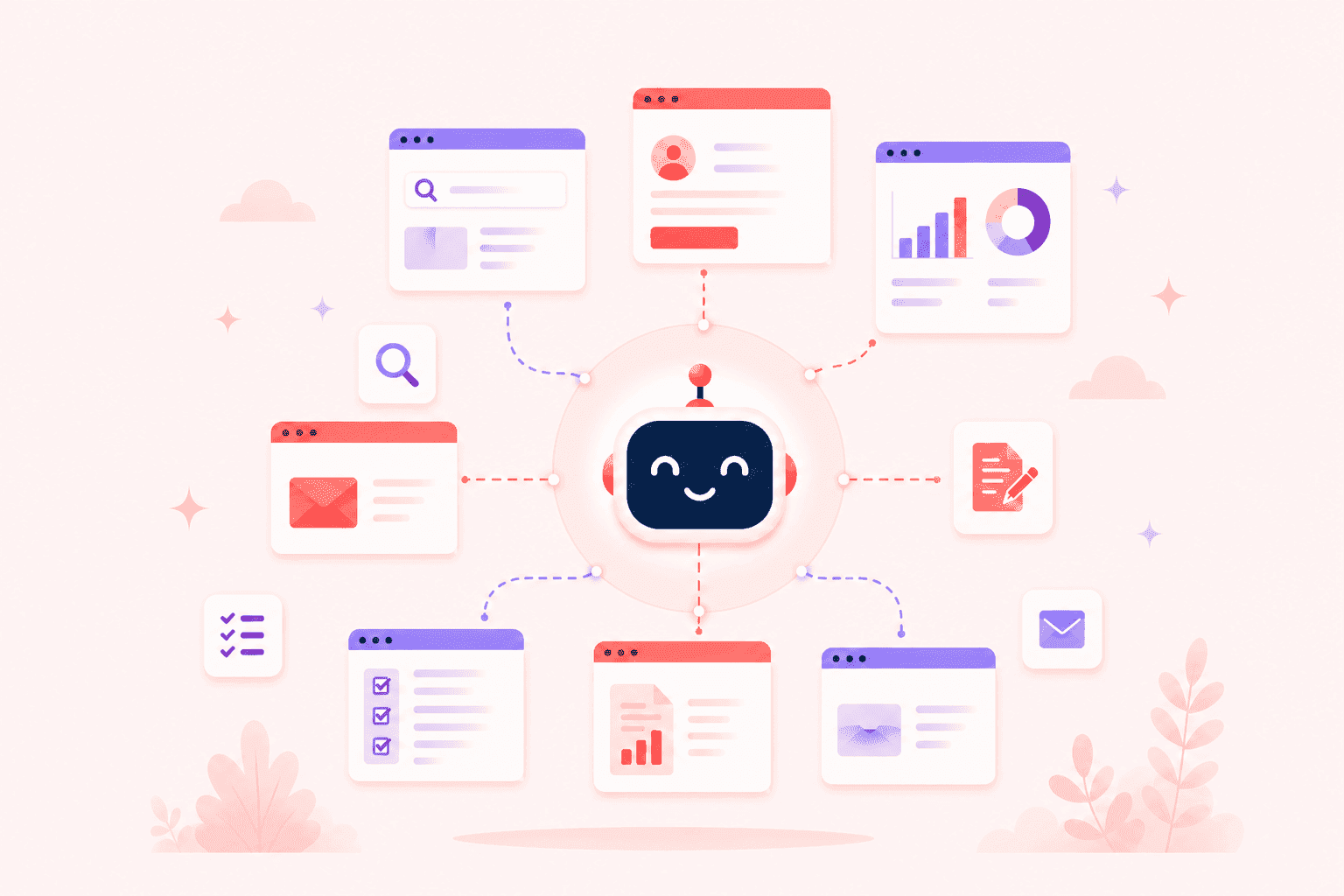
An AI browser agent is an AI-powered system that can interact with websites much like a person would. It can open a browser, understand what's displayed on the screen, click buttons, fill out forms, search for information, move between web pages, and complete tasks based on a goal instead of a fixed set of steps.
They can adapt to changes on a website, making them more flexible than traditional browser automation. Businesses use these Intelligent Web Agents to automate repetitive browser-based tasks, improve productivity, reduce manual effort, and streamline daily operations. As a result, AI browser automation is becoming an important part of modern business automation across industries.
How AI Browser Agents Work
AI Browser Agents work with a goal rather than a script. Instead of telling the system every click to make, users simply describe what they want to accomplish. The agent then understands the request, identifies the information it needs, and decides how to complete the task.
Imagine asking someone to complete a task. You wouldn't describe every single step; you'd simply say what needs to be done. An AI browser agent follows the same way. It understands the request, figures out where to go, interacts with the required websites, and completes the task without needing constant guidance.
What happens if a webpage looks slightly different than before? Or a button has moved to another location? Unlike traditional browser automation, which often stops when something changes, AI browser agents can recognize these small changes and continue working whenever possible. That flexibility is what makes them useful for real business environments, where websites and applications are constantly evolving.
Rather than automating one action at a time, these intelligent web agents are built to complete an entire workflow from start to finish. That's why more organizations are investing in AI browser agent development to improve business automation, reduce repetitive work, and help employees spend more time on meaningful tasks instead of routine browser activities.
How AI Browser Agents Think and Act
An AI browser agent doesn't think like a human, but it follows a logical process to complete a task. Once it receives a request, it first understands the objective and identifies what needs to be achieved.
As the agent moves through different web pages, it continuously observes the information displayed on the screen. It recognizes page elements such as buttons, forms, menus, tables, and text, then determines the next appropriate action based on the current context. Instead of following a rigid path, it evaluates each step before moving forward.
If it encounters unexpected situations, such as a changed page layout or missing information, it can reassess the workflow and choose an alternative approach whenever possible. This combination of planning, reasoning, browser interaction, and decision-making enables AI browser agents to handle complex browser-based workflows more effectively. That's why AI browser agent development is becoming an important part of modern AI workflow automation and enterprise business automation.
Real-World Business Use Cases
Where are businesses using AI browser agents today? It can be anywhere employees spend time working with websites or web applications every day.
Take a sales team, for example. Instead of manually collecting leads from different websites and updating the CRM, an AI browser agent can handle the repetitive work while the team focuses on building customer relationships.
In customer support, agents often switch between multiple systems to verify customer information or process requests. AI browser agents can complete these browser-based tasks in the background, helping support teams respond faster and more efficiently.
The same applies to finance and related operations. From downloading reports and updating records to checking application status and gathering information from different portals, repetitive browser tasks can be completed with minimal manual effort. Marketing teams can also use browser agents to monitor competitor websites, collect market insights, or track pricing updates without spending hours doing it themselves.
No matter the industry, the goal remains the same: reduce repetitive work so teams can spend more time on activities that add real value to the business. That's why businesses across healthcare, retail, banking, manufacturing, logistics, and many other industries are adopting AI browser agents to improve productivity and build smarter, more efficient workflows.
AI Browser Agents vs Traditional Browser Automation
At first glance, AI browser agents and traditional browser automation seem similar because both help automate browser-based tasks. However, the way they work is different. Traditional automation follows a fixed set of rules, while AI browser agents are designed to understand goals, adapt to changes, and complete tasks more intelligently.
| Feature | AI Browser Agents | Traditional Browser Automation |
|---|---|---|
| How it works | Understands the goal and decides how to complete the task. | Follows a predefined script step by step. |
| Instructions | Accepts natural language instructions. | Requires every action to be programmed. |
| Flexibility | Can adjust to small changes on a webpage. | Often stops working if the page changes. |
| Decision-making | Chooses the next action using the information it finds. | Cannot make decisions beyond the written rules. |
| Handling complex tasks | Can manage multi-step workflows across different websites. | Best suited for repetitive and predictable tasks. |
| Maintenance | Usually needs fewer updates because it can adapt. | Requires regular updates whenever websites change. |
| User involvement | Minimal human intervention after the task starts. | Frequent monitoring and script updates may be required. |
| Business use | Ideal for intelligent business workflows and enterprise automation. | Suitable for basic browser automation tasks. |
| Scalability | Easily supports changing business processes. | Scaling often requires creating and maintaining additional scripts. |
AI Browser Agent Development Process
A well-planned AI browser agent development process ensures the final solution is reliable, scalable, and aligned with business needs. Here's how the process typically works.
Step 1: Understand the Business Goals
Every project begins by identifying what the business wants to achieve. The team discusses the challenges, the repetitive browser tasks that need automation, and the expected outcome. This stage lays the foundation for successful AI agent development and helps ensure the browser agent is built to solve the right problem.
Step 2: Analyze the Workflow
Once the goal is clear, the complete workflow is analyzed. This includes understanding which websites or web applications the agent will use, what information it needs, and how the task should move from start to finish. Careful planning helps businesses build AI browser agents for business automation that match their day-to-day operations.
Step 3: Design the Browser Agent
Next, the browser agent is designed based on the workflow. At this stage, developers decide how the agent will interact with web pages, respond to different situations, and complete tasks efficiently while keeping the experience reliable and secure.
Step 4: Build and Integrate the Agent
The development team then builds the browser agent and connects it with the required business systems, such as CRM platforms, ERP software, databases, or other internal applications. These integrations allow the agent to become part of the existing business workflow and support enterprise workflow automation across different departments.
Step 5: Test the Solution
Before deployment, the browser agent is carefully tested to identify and fix any issues. The team checks its accuracy, handles possible errors, and fine-tunes the workflow to improve performance. This helps create Autonomous Browser Agents that can work more reliably in real-world environments.
Step 6: Deploy and Continuously Improve
Once testing is complete, the browser agent is deployed into the production environment. Even after deployment, the work doesn't stop. The agent is monitored regularly, updated when websites or business processes change, and improved over time to keep delivering reliable results.
Following a structured AI browser agent development process helps businesses build browser agents that are accurate, scalable, and ready to support long-term business automation goals. A well-developed solution also becomes a valuable part of broader AI automation solutions, helping organizations improve efficiency and simplify repetitive browser-based work.
AI Browser Agent Development Cost
| Project Type | Estimated Cost (USD) | Typical Features |
|---|---|---|
| MVP (Minimum Viable Product) | $2,000 to $5,000 | Automates a single workflow, basic browser interactions, limited integrations, suitable for proof of concept. |
| Basic AI Browser Agent | $5,000 to $15,000 | Supports multiple browser tasks, simple decision-making, basic reporting, and connects with one or two business applications. |
| Mid-Level AI Browser Agent | $15,000 to $35,000 | Handles multiple workflows, integrates with CRM/ERP systems, advanced automation, better security, monitoring, and reporting. |
| Enterprise AI Browser Agent | $35,000 to $100,000+ | Enterprise integrations, complex workflows, advanced reasoning, role-based access, high security, scalability, analytics, and ongoing optimization. |
For example, automating a single website is usually less expensive than managing workflows across multiple web applications. Similarly, integrating the browser agent with CRM platforms, ERP systems, internal databases, or third-party APIs can increase the overall project scope. Security requirements, compliance standards, custom AI capabilities, testing, deployment, and ongoing support also play an important role in determining the final investment. The cost also vary depending on whether you're building custom AI browser agent development solutions or large-scale enterprise AI browser agents that support multiple business processes.
Start with an MVP, it allows you to validate the idea, measure business value, and gather feedback before investing in a larger enterprise solution. As your requirements grow, you can expand the MVP into a complete AI web agent solution that supports business automation with AI across different teams.
Conclusion
At Tart Labs, we specialize in building custom AI browser agents that help businesses reduce manual work and improve the way browser-based processes are handled. As an experienced AI browser agent development company, we offer AI browser automation services that help businesses simplify repetitive browser tasks through AI-powered browser automation. From idea validation and MVP development to enterprise-grade AI automation solutions, our team can help you develop browser agents that deliver measurable business value.
If you're planning to build an AI browser agent or explore how browser automation AI can transform your operations, contact Tart Labs. Our team will discuss your business needs, answer your questions, and help you choose the best approach for your browser automation project.