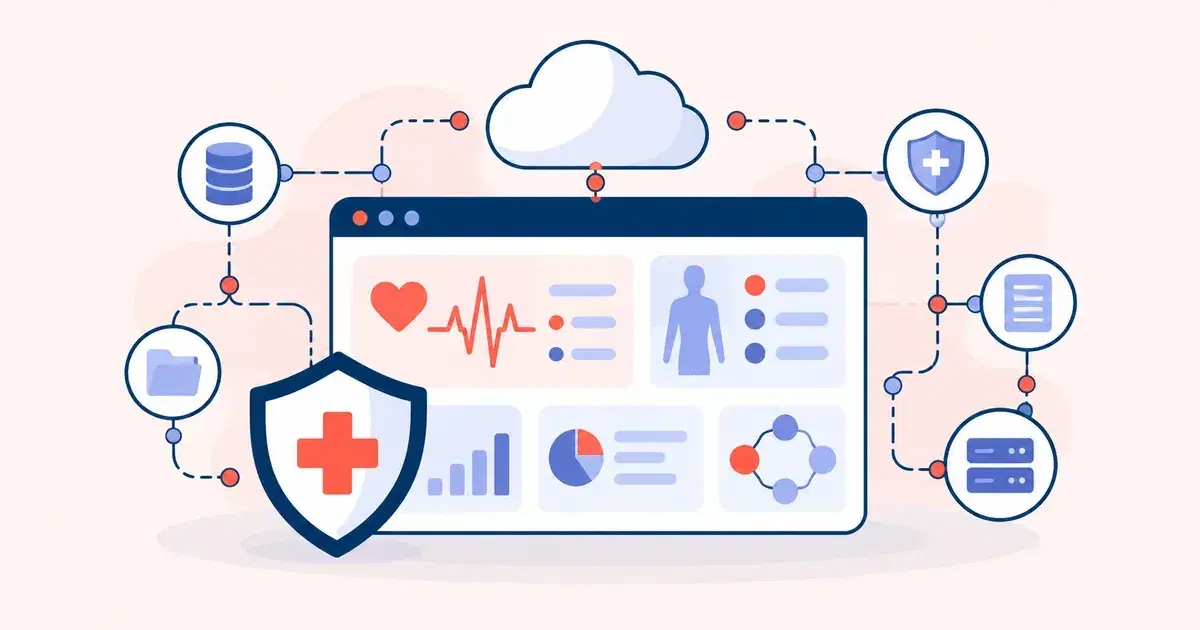
A scalable healthcare web application is one that stays fast, correct and compliant as patients, clinicians, integrations and data volumes grow. In practice that means five decisions made early: model data around FHIR, put identity and audit logging at the center, isolate tenants, keep stateless services behind queues and caches, and design every dependency to fail without taking clinical workflows down. Scale without security is a liability in this sector, and security bolted on late is the most expensive kind.
Build to the proposed HIPAA Security Rule now. The January 2025 proposal is not final. A July 2026 McDermott alert reports that final action is now projected for July 2027, but mandatory encryption and multi-factor authentication are easier to adopt early than to retrofit.
India has its own rules. The DPDP Rules bring core obligations into force around mid-May 2027, including a 72-hour detailed breach notice to the Data Protection Board.
Scale the stateless parts. Keep PHI access behind a small, well-audited service layer and scale everything else horizontally.
Test failure, not just load. A clinical system that is fast but loses a queue message is worse than a slow one.
Frequently Asked Questions (FAQ)
A scalable healthcare application handles growth in users, data, integrations and compliance demands without slowing down or weakening security. It relies on stateless services, queues for slow or unreliable dependencies, a well-tuned data tier, tenant isolation and tested recovery plans.
Let's connect and create something amazing together!
Got an idea or project in mind? Whether it's custom software, a dedicated dev team, or help with digital transformation, we're here for it. Reach out—we'll bring your vision to life.
Contact us
Prefer to speak directly? You’ll find our address, email, and contact details right here.
Office Location
Block A1 Third Floor, Rathinam TechZone, SEZ Campus Pollachi Main Road, Eachanari, Coimbatore, Tamil Nadu 641021, India
Thinking through a new idea or stuck with a challenge? Drop us a message—we'll listen, brainstorm, and help move things forward.
What "Scalable" Means in Healthcare
In most software, scaling means serving more requests. A health platform has to grow along four axes at once, and a design that covers only one of them will stumble on the rest.
Dimension
What grows
What breaks if you ignore it
Load
Concurrent users, peak-hour logins, bulk imports
Slow charting, timeouts during shift change
Data
Records, documents, images, device streams
Slow search, runaway storage and backup cost
Integration
EHRs, labs, payers, devices, partners
Brittle point-to-point interfaces
Compliance
Jurisdictions, tenants, audit demands
Rework every time a new customer or rule appears
Healthcare traffic is often spiky in ways you can plan for. Logins cluster at shift changes, and claims batches often run overnight. Measure your own pattern, because capacity plans built on it cost less than flat over-provisioning.
Principle 1: Model Data Around FHIR From Day One
HL7 FHIR is the REST-and-JSON standard for exchanging health data, and U.S. regulation now points at it. The CMS interoperability rule names FHIR Release 4.0.1 as the required standard for impacted payers, alongside USCDI data classes and implementation guides. The covered payers are Medicare Advantage organizations, state Medicaid and CHIP fee-for-service programs, Medicaid managed care plans, CHIP managed care entities and QHP issuers on the federally facilitated exchanges.
If you build for providers, vendors or digital health, you may not be a covered payer, but your customers' APIs will be FHIR-shaped, so your integrations will be too.
Practical guidance:
Keep an internal model and a FHIR facade. Do not force your whole database into FHIR resources, which are designed for exchange, not for every query pattern. Store data in the shape your product needs and expose a FHIR layer that maps to it.
Use standard terminologies. Map diagnoses, medications and lab results to ICD-10, SNOMED CT, LOINC and RxNorm at the edge so downstream systems agree on meaning.
Version your interfaces. Pin the FHIR version and profile set you support, and publish a capability statement so partners know what to expect.
Prefer events over polling. Emit change events for admissions, results and orders so consumers do not hammer your API.
Principle 2: Treat Security as an Architectural Feature
Most security work in this sector comes down to limiting the damage when something goes wrong. The OCR portal's pattern, with more than 80% of large breaches reported in 2025 coming from hacking and IT incidents, per the HIPAA Journal's tally of the OCR breach portal, means the perimeter is not the plan. Plan on an attacker eventually holding a valid credential, and make sure it opens as little as possible.
The HIPAA Security Rule today treats several safeguards as "addressable." The proposal published in January 2025 would remove that distinction and make controls such as encryption of ePHI and multi-factor authentication required. The proposal is still not final, and McDermott's July 2026 alert reports that final action is now projected for July 2027. Do not wait. Teams that adopt these controls now avoid a retrofit later, and many buyers' security reviews already ask about them.
A baseline that holds up in 2027:
Encrypt everywhere. TLS for all traffic including internal service calls, and encryption at rest with keys held in a managed key service, rotated on a schedule.
Require multi-factor authentication for every user who can reach PHI, and for every administrator, without exceptions for convenience.
Enforce least privilege with role- and attribute-based access control. A billing clerk, a nurse and a data analyst should see different slices of the same record.
Support break-glass access. Clinicians sometimes need emergency access outside their usual scope. Allow it, require a reason, and flag it for review.
Keep secrets out of code and images. Use a secrets manager and short-lived credentials.
Minimize PHI in non-production. Use synthetic or de-identified data in development and test environments.
Scan and patch continuously. Dependency scanning in CI, container image scanning and a defined window for critical fixes.
Principle 3: Audit Everything That Touches PHI
HIPAA requires audit controls (45 CFR 164.312(b)), and in practice the audit trail is also your best incident-response tool. Design it as a first-class service, not as scattered log statements.
Log who, what, when, why and from where for every read, write, export and permission change involving PHI.
Make logs append-only and ship them off the application hosts, so a compromised server cannot rewrite its own history.
Keep PHI out of the logs themselves. Log record identifiers, not names or diagnoses.
Build the review workflow. A log nobody queries does not satisfy an access report request or catch snooping on a celebrity's chart.
Audit volume tends to surprise teams, because reads typically outnumber writes. Plan storage tiers and retention from the start, and write audit events asynchronously through a queue so logging never slows a clinician's screen.
Principle 4: Architect for Horizontal Scale
Few healthcare web apps need microservices on day one. What they need is clear boundaries, so a split stays possible later.
Start with a modular monolith or a small set of services organized around domains such as scheduling, clinical documentation, billing and messaging. Enforce module boundaries in code so that extracting a service later is a deployment change, not a rewrite.
Keep services stateless. Store session state in a shared cache or signed tokens so any instance can serve any request, and add instances behind a load balancer when traffic rises.
Scale the data tier deliberately:
Use read replicas for reporting and search-heavy screens.
Move full-text and cohort search into a dedicated search index rather than overloading the primary database.
Store documents and images in object storage with signed, expiring URLs, and keep metadata in the database.
Partition large append-heavy tables such as device readings and audit events by time.
Use queues for anything slow or unreliable: claims submission, HL7 and FHIR deliveries, notification sending and report generation. A queue turns an outage in a partner system into a delay instead of a failed user action.
Cache with care. Cache reference data, such as code sets and formularies, aggressively. Cache patient-specific data only with short lifetimes, per-user keys and clear invalidation, because stale clinical data is a safety issue.
Principle 5: Isolate Tenants Properly
Serving several clinics, hospitals or payers from one platform makes tenant isolation both a security control and a scaling strategy.
Model
How it works
Best fit
Shared database, tenant ID on every row
Lowest cost, enforced by row-level security
Many small tenants with similar needs
Schema per tenant
Stronger separation, moderate overhead
Mid-sized tenants, per-tenant migrations
Database or account per tenant
Strongest isolation, highest cost
Large health systems, strict data-residency demands
Many platforms use a hybrid: pooled infrastructure for small customers and dedicated stacks for large ones. Whatever you choose, enforce isolation in the database layer with row-level security and not only in application code, and test cross-tenant access explicitly. A missing WHERE tenant_id = ? is a classic breach path. Picture a developer adding a new reporting query and forgetting the tenant filter: it passes every test that uses one clinic's data, then returns another clinic's records in production. Row-level security in the database stops that class of mistake even when the application code gets it wrong. In PostgreSQL, for example, the policy looks like this:
ALTER TABLE encounters ENABLE ROW LEVEL SECURITY;

CREATE POLICY tenant_isolation ON encounters
  USING (tenant_id = current_setting('app.tenant_id')::uuid);
The application sets app.tenant_id once per request from the authenticated session, and every query on the table is filtered from then on. (This is an illustrative scenario, not a client case.)
Also plan for data residency early. Some customers need data kept in a given country or region, which is far easier to support if region is a deployment parameter from the start.
Principle 6: Design for Failure and Recovery
People use clinical systems when they are unwell, which makes uptime a patient-safety question.
Define recovery objectives per workflow. Medication ordering may need near-zero data loss and minutes of recovery. A reporting dashboard can wait hours.
Deploy across multiple availability zones and test failover on a schedule, not for the first time during an outage.
Back up and rehearse restores. Immutable, offline-capable backups matter most against ransomware, and a backup you have never restored is a guess.
Degrade gracefully. If the lab interface is down, let clinicians keep charting and queue the results. Provide a read-only downtime view of critical data.
Use idempotent operations. Retries after a timeout must not create duplicate orders or double-bill a claim.
Load test with realistic data and shift-change patterns, and run failure drills alongside them.
Principle 7: Performance and Usability
A slow screen costs clinicians time and encourages workarounds. Set performance budgets for the screens used most, such as the patient chart, medication list and scheduling grid, and measure real user timing with realistic record sizes. A chart for a long-term patient with years of history loads very differently from a demo record.
Good UI/UX design belongs in this conversation too. Clear information hierarchy, accessible color contrast and keyboard-friendly workflows reduce errors, and accessibility requirements often appear in health-system procurement.
Principle 8: Delivery Pipelines
Growing a team is as hard as growing a system. A mature DevOps pipeline gives you the evidence trail compliance needs without slowing releases:
Infrastructure as code, reviewed and versioned, so environments are reproducible.
Automated tests, security scans and approvals in CI, with the results stored as evidence.
Separate, access-controlled production environments with change records.
Progressive rollouts and fast rollback, so a bad release does not become an incident.
Hosting on a major cloud provider under a signed business associate agreement is standard, but the agreement does not make your application compliant. You still own configuration, access control and logging. A cloud-native approach with managed services reduces the number of components you must secure and patch yourself.
Compliance in India: DPDP Act and ABDM
Everything above on HIPAA and CMS applies to US data. If you build or host for Indian providers or patients, two Indian frameworks apply instead, and one of them reaches its main deadline in the 2027 planning window.
The DPDP Act and Rules. India notified the Digital Personal Data Protection Rules in November 2025, as described in the PIB release and Khaitan & Co's analysis. The rollout is phased: the conditions for registering consent managers apply after one year, in November 2026, and the core obligations on consent and on data fiduciaries apply after 18 months, in mid-May 2027. Points that shape engineering work:
Security safeguards. The Rules list measures such as encryption, obfuscation and masking. The list is indicative, so choose controls to match the sensitivity of the data you process.
Breach notification. A data fiduciary must tell the Data Protection Board without undue delay, then send a detailed notification within 72 hours of becoming aware of the breach, unless the Board allows longer.
Log retention. Per Khaitan's summary, personal data, traffic data and logs from processing must be retained for at least one year, for the purposes the Rules specify. Plan log storage accordingly.
Consent. Withdrawing consent must be as simple as giving it, so build withdrawal into the product from the start.
Healthcare exemption. The Rules exempt clinical establishments and healthcare professionals from the restriction on behavioural monitoring of children, but only for providing healthcare services. Treat it as narrow.
ABDM. The National Health Authority runs the Ayushman Bharat Digital Mission, a federated, consent-based health data network built on open standards, with FHIR as its exchange format. A product joins as a Health Information Provider (HIP), a Health Information User (HIU) or both, and records move between them only with the patient's consent, linked through the patient's ABHA health ID. Certification steps and the FHIR profiles change over time, so work from the current ABDM sandbox documentation.
Building for both. A product that serves US and Indian customers can share one architecture: a FHIR facade, an append-only audit log, encryption and MFA, tenant isolation, and region as a deployment parameter so Indian patient data stays in an Indian region where the customer requires it. What changes per market is the legal layer: business associate agreements and OCR breach reporting in the US, consent records, ABDM integration and the 72-hour DPDP notice in India. Have counsel confirm the details for your case, because the Rules are new and guidance is still developing.
Where AI Fits
Many teams now add AI features such as clinical note summarization, coding assistance or patient messaging triage. Treat these like any other component that touches PHI: confirm the vendor will sign a business associate agreement, keep prompts free of unnecessary identifiers, log inputs and outputs for audit, and keep a clinician in the loop for decisions that affect care. For planning guidance, see our overview of AI strategy for software companies and our AI development services.
A 2027 Readiness Checklist
Use this list in architecture reviews:
Internal data model with a documented FHIR R4 mapping and pinned profiles
MFA enforced for all PHI access and all admin roles
Encryption in transit and at rest, with managed and rotated keys
Role- and attribute-based access control, plus reviewed break-glass access
Append-only audit log covering reads, writes, exports and permission changes
Tenant isolation enforced in the database and covered by automated tests
Queues for partner integrations, with idempotent handlers and dead-letter review
Documented recovery objectives per workflow, with a restore drill in the last quarter
Synthetic data in all non-production environments
A breach runbook that covers every market you serve, including the 72-hour DPDP notice in India
A named owner for tracking the HIPAA Security Rule's final text, CMS API milestones and DPDP guidance
Common Mistakes to Avoid
Treating compliance as a launch gate. Retrofitting audit logging or tenant isolation into a live system is usually harder than designing it in.
Over-fitting the database to FHIR. Exchange formats make poor internal schemas.
Scaling the app but not the integrations. Partner systems are usually the first bottleneck.
Logging PHI in plain text. Debug logs are a frequent and avoidable exposure.
Skipping restore tests. Ransomware turns an untested backup into a crisis.
What to Do in the Next 90 Days
Map every system that stores or transmits PHI and confirm each has encryption, MFA and logging.
Pick the two or three workflows where downtime hurts most and write recovery objectives for them.
Review your integration list against the January 1, 2027 CMS API date if you sell to US payers, and against ABDM if you serve Indian providers.
Run one restore drill and one cross-tenant access test, and fix what they find.
Assign an owner for regulatory tracking, since both the HIPAA Security Rule timeline and CMS requirements are still moving.
The Bottom Line
Healthcare web applications scale well when the unglamorous parts are done early: standards-based data exchange, security by default, complete audit trails, clean tenant boundaries and rehearsed recovery. The 2027 deadlines add urgency, and the 2026 breach data shows the price of delay. If you are planning a new platform or modernizing an existing one, get in touch and our team will review your architecture with you.
A 2027 guide to mobile app performance: startup time, crash and ANR budgets, rendering, networking, battery and UX, with Google's published thresholds.
A seven-stage guide to building a mobile app for 2027: validation, native vs cross-platform, design, build, testing, store launch and post-launch growth.