Want to build an AI MVP? Learn the AI MVP development process, costs, key features, benefits, and tips to launch your AI solution successfully.
By Tart Labs·Published
Want to start a Project?
share
share
Introduction
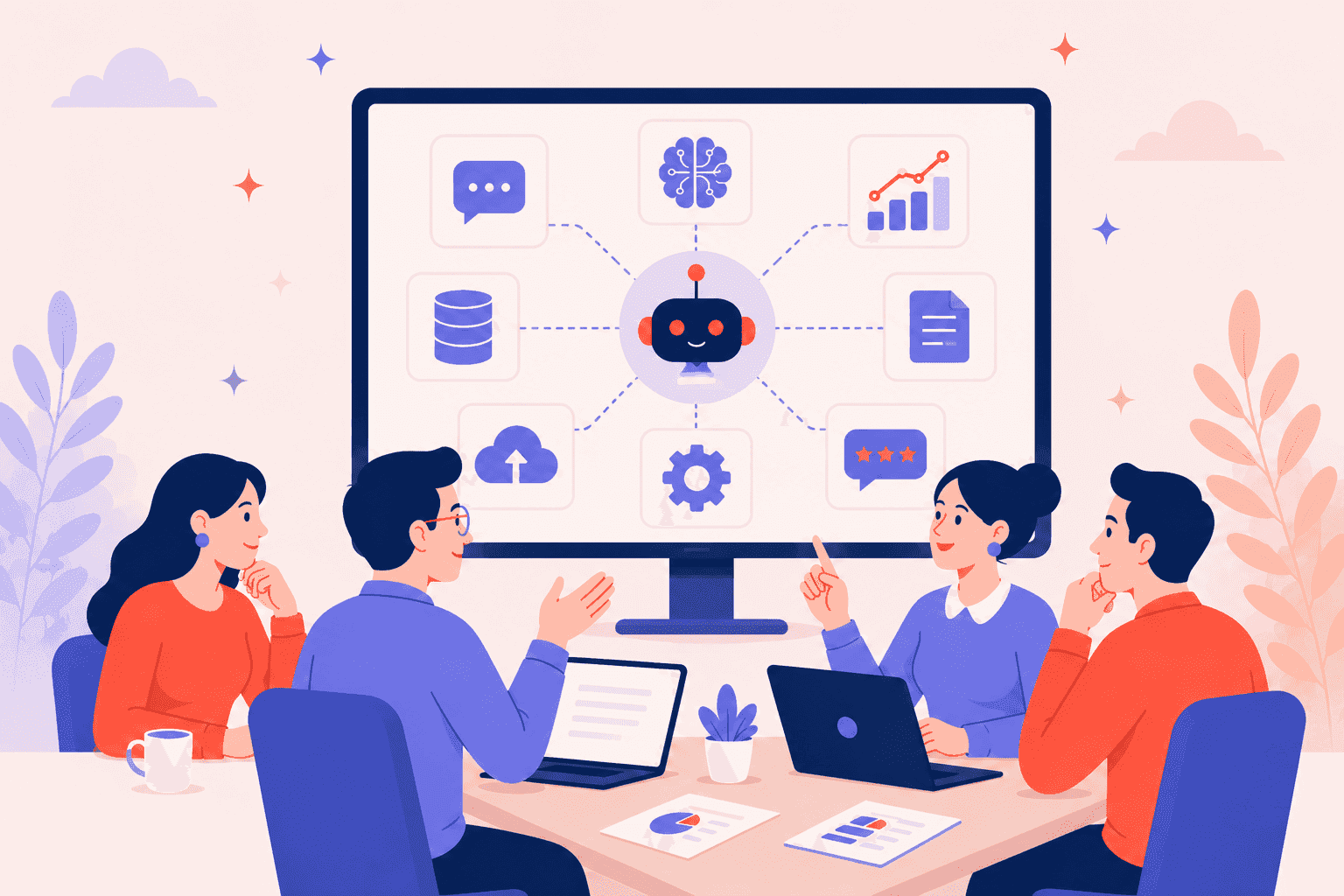
Validate your AI-powered product idea before complete development. Starting with a full-scale build can be risky, especially when you have not yet confirmed whether users truly need the solution. An AI MVP helps you test the core idea quickly, gather feedback from real users, and make better choices for future updates.
Building an AI MVP involves more than adding a chatbot or connecting an AI model to an app. You need the right use case, quality data, smooth user flows, reliable model integration, and a backend that can support real-world usage. Whether you are creating an AI chatbot, AI copilot, AI agent, document processing tool, recommendation engine, predictive analytics solution, or voice AI application, the goal is the same: validate the idea, reduce development risk, and build only what users actually need. The experienced AI MVP development company makes the solution reliable.
In this AI MVP Development Guide, you will learn what an AI MVP is, when to build one, the different types of AI MVPs, the step-by-step AI MVP Development process, essential features, estimated costs, and how to choose the right partner for Custom AI Development.
What Is an AI MVP?
An AI MVP is an early version of an AI product built around one main business use case. Instead of developing every feature, it focuses on a core AI capability, such as AI chat, recommendations, predictions, or document understanding.
The goal of AI MVP Development is to validate the idea, test AI performance, gather real user feedback, and reduce investment risk. An AI Product MVP helps businesses improve the product based on real-world usage before moving to full AI Product Development.
When Does Your Business Need an AI MVP?
Not every business needs a complete AI solution from the beginning. An AI MVP helps businesses test an idea, validate market demand, and improve processes before making a large investment. Here are some common situations where building an AI Product MVP is the right choice.
Startups Testing New Ideas
Startups often have limited budgets, so building a complete product without validation can be risky. An AI MVP for Startups helps test product-market fit, collect user feedback, and attract investors with a working prototype. Examples include AI writing assistants, AI travel planners, AI recruitment tools, AI fitness coaches, and AI learning platforms.
Enterprises Exploring AI
Many businesses want to adopt AI but are unsure where to begin. AI MVP Development allows enterprises to run pilot projects, test AI with existing systems, and measure business value before expanding. Common Enterprise AI Solutions include AI knowledge assistants, document analysis, customer support, contract review, and reporting tools.
Frequently Asked Questions (FAQ)
An AI MVP helps businesses test their idea early and decide the right direction for their product. It allows teams to understand user needs, validate the AI solution, and improve the product before adding more features.
Let's connect and create something amazing together!
Got an idea or project in mind? Whether it's custom software, a dedicated dev team, or help with digital transformation, we're here for it. Reach out—we'll bring your vision to life.
Thinking through a new idea or stuck with a challenge? Drop us a message—we'll listen, brainstorm, and help move things forward.
SaaS Product Enhancement
SaaS companies can use an AI MVP to introduce one AI feature before releasing it to all users. This helps measure adoption, gather customer feedback, and reduce feature development risk. Popular additions include AI content generation, smart search, analytics, email drafting, workflow suggestions, and AI summaries.
Internal Process Automation
In many businesses, everyday tasks still require people to do everything manually. An AI MVP helps automate one process first, measure productivity improvements, and expand gradually. Common use cases include AI document processing, invoice extraction, HR onboarding support, meeting summaries, email classification, and knowledge search using AI Development Services.
Customer-Facing AI Applications
Businesses can improve customer experiences without building a full AI platform. An AI MVP helps test customer adoption, response quality, and satisfaction before scaling. Examples include AI chatbots, voice assistants, shopping assistants, recommendation engines, banking assistants, and healthcare assistants that offer faster, personalized support.
An AI MVP is a smart choice whenever you want to validate an idea before investing significant time and money. Whether you're building a new product, improving an existing platform, automating business processes, or enhancing customer experiences, AI MVP Development provides a practical, low-risk way to innovate.
Choosing the right type of AI MVP Development helps businesses validate ideas faster, reduce risk, and get better results from AI Product Development.
AI Chatbots
AI chatbots understand user questions and provide instant, natural responses. They help businesses answer queries, offer support, and improve customer interactions without requiring human involvement every time.
AI copilots assist users by providing smart suggestions while they work. They improve productivity by helping with writing, coding, and content creation.
Common Features
Content generation
Email drafting
Code suggestions
Document summaries
Common Use Cases
Coding assistant
Sales copilot
Marketing assistant
Customer support
Benefits
Higher productivity
Less manual work
Faster task completion
Better decision-making
AI Agents
AI agents help complete business tasks by following user interactions and using connected applications when needed.
Recommendation engines help businesses display relevant products, content, or services to each user instead of showing the same options to everyone.
Common Features
Personalized suggestions
User behavior analysis
Similar item recommendations
Trending content
Common Use Cases
Product recommendations
Course suggestions
Movie recommendations
Personalized news
Benefits
Higher engagement
Better customer retention
Increased sales
Improved user experience
Document Processing Systems
AI document processing automatically extracts, organizes, and summarizes information from business documents, reducing manual work and improving accuracy.
Common Features
OCR
Data extraction
Document classification
AI summaries
Common Use Cases
Invoice processing
Contract review
Claims processing
KYC verification
Benefits
Faster processing
Fewer errors
Lower operational costs
Better efficiency
Computer Vision Applications
Computer vision helps AI work with images and videos to recognize objects, identify patterns, and support business operations.
Common Features
Object detection
Image classification
OCR
Facial recognition
Common Use Cases
Quality inspection
Medical imaging
Shelf monitoring
Face authentication
Benefits
Better accuracy
Faster inspections
Less manual work
Improved quality control
Predictive Analytics Solutions
Predictive analytics helps businesses understand possible future results by finding useful patterns in available data.
Common Features
Sales forecasting
Trend analysis
Risk prediction
Churn prediction
Common Use Cases
Demand forecasting
Inventory planning
Fraud detection
Customer retention
Benefits
Better planning
Lower business risk
Smarter decisions
Improved forecasting
Voice AI Applications
Voice AI allows users to interact with applications using spoken language, making digital experiences faster, simpler, and more accessible.
Common Features
Speech recognition
Voice commands
Text-to-speech
Multi-language support
Common Use Cases
Voice assistants
IVR automation
Voice banking
Healthcare support
Benefits
Faster interactions
Better accessibility
Improved user experience
Reduced support workload
Step-by-Step AI MVP Development Process
A structured AI MVP Development Process helps businesses solve the right problem, reduce risks, and make better investment decisions. Let's explore how to build an AI MVP step by step.
Step 1. Define the Business Problem
Every successful AI MVP Development project starts with a clear business problem. Instead of building AI because it is popular, identify a real challenge that affects your business or customers. Define what success looks like, understand your business goals, and involve key stakeholders. A clear problem statement helps the entire team stay focused throughout AI Product Development.
Step 2. Validate the AI Use Case
Not every business problem requires AI. Before investing in development, validate whether AI is the best solution for your use case. Study customer needs, evaluate technical feasibility, analyze competitors, and estimate business value. This step helps ensure your AI MVP solves a real problem.
Step 3. Identify Your Target Users
A successful AI product starts with understanding the people who will use it. Identify your target users, understand their challenges, and learn how they use your product in real situations. Creating user personas and mapping customer journeys helps your AI MVP solve real problems instead of relying on assumptions during AI Product Development.
Step 4. Prioritize Core AI Features
Your AI MVP should focus on solving one problem exceptionally well rather than including too many features. List every possible feature, then identify the ones that solve real problems. Core capabilities such as AI chat, recommendations, document summarization, or AI search should come first, while additional features can be added in future releases.
Step 5. Collect and Prepare Data
Collect relevant information, remove duplicate or incorrect data, organize your knowledge sources, and follow privacy and security requirements. Well-prepared data improves AI accuracy and creates a strong base for successful AI MVP Development.
Step 6. Choose the Right AI Model
The AI model you choose impacts how well your product works. Pick an AI model that can support the features you want to offer. Comparing different models before development helps you build a reliable, scalable, and cost-effective AI solution.
Step 7. Design the User Experience
Users should find your AI product simple, clear, and easy to use. Create intuitive user flows, clean interface designs, and natural AI conversations that guide users through each task. Adding loading states, feedback options, and helpful error messages also builds trust and improves the overall user experience.
Step 8. Build the AI MVP
After planning and designing, it's time to build the working product. This stage includes frontend and backend development, AI model integration, database setup, authentication, APIs, and cloud deployment. Whether using Custom AI Development or existing AI services, the goal is to create a functional AI Product MVP that users can test.
Step 9. Test with Real Users
Real user feedback is one of the most valuable parts of the AI MVP Development Process. Ask users to try the product, review AI responses, identify usability issues, and collect suggestions for improvement. This helps validate your idea, improve AI performance, and prepare the product for wider adoption.
Step 10. Measure Performance and Iterate
An AI MVP continues to improve even after launch. Track product performance, user behavior, and business results to find opportunities for future updates. Use these insights to refine prompts, optimize costs, improve AI accuracy, and introduce new features that provide greater value over time.
A successful AI MVP doesn't need dozens of features. It only needs the necessary features to see how the idea performs with real users. During AI MVP Development, the focus should be on creating a simple, usable product that collects user feedback, measures AI performance, and provides a strong foundation for future improvements.
Authentication
Authentication verifies a user's identity before allowing access to the AI application. It protects user accounts, keeps business data secure, and enables personalized experiences. Common methods include email and password, Google Sign-In, Microsoft Sign-In, Single Sign-On (SSO), and Multi-Factor Authentication (MFA). This feature improves security and provides better access control.
AI Chat Interface
The AI chat interface gives users an easy way to send requests and get answers from the AI. A simple and responsive chat experience makes the product easy to use and encourages regular interaction. Features such as chat history, suggested prompts, conversation context, and streaming responses help deliver a smoother and more engaging user experience.
Prompt Management
Prompt management helps teams create, update, and refine the prompts that control AI output. Instead of changing application code, teams can update prompts quickly to improve response quality. Features like prompt templates, version control, testing, and optimization help deliver more accurate answers while making future updates easier.
Knowledge Base Integration
Knowledge base integration connects the AI with business information such as PDFs, documents, FAQs, websites, databases, and internal files. This helps the AI generate better responses based on business-specific data. It also reduces incorrect answers and helps users receive information based on the latest business knowledge.
File Upload Support
File upload support allows users to upload documents for AI analysis. The AI can process files such as PDFs, Word documents, Excel sheets, CSV files, images, and presentations. This feature is useful for tasks like contract review, invoice processing, resume screening, and document summarization, reducing manual effort and saving time.
User Feedback Collection
User feedback helps businesses understand how well the AI is performing. Simple options, such as like or dislike buttons, star ratings, feedback forms, comments, and bug reports, make it easy to collect opinions. This information helps improve AI responses, fix issues, and build a better product over time.
Usage Analytics
Usage analytics shows how people interact with your AI MVP. It tracks important metrics such as active users, feature usage, response time, session duration, and user retention. These insights help businesses understand user behavior, improve product performance, and make better decisions for future development.
Admin Dashboard
An admin dashboard gives businesses a single place to manage the AI application. Teams can monitor users, review analytics, manage prompts, update the knowledge base, track API usage, and check system performance. This makes the application easier to maintain while supporting continuous improvements and better overall management.
AI MVP Development Cost
AI MVP Development Cost varies from one project to another. Factors such as AI features, integrations, data quality, cloud infrastructure, and third-party APIs all influence the overall budget. Unlike traditional software, AI MVPs also include costs for AI models, vector databases, and ongoing monitoring. Since every project has different requirements, there is no fixed AI MVP Cost.
AI MVP Cost by Project Complexity
MVP Type
Estimated Cost (USD)
Timeline
Best For
Basic AI MVP
$8,000 to $20,000
4 to 8 weeks
Startups, PoCs
Medium AI MVP
$20,000 to $60,000
2 to 4 months
SaaS, SMBs
Advanced AI MVP
$60,000 to $150,000+
4 to 8+ months
Enterprise solutions
AI MVP Cost by Application Type
Different AI applications require different levels of development, integrations, and testing.
AI Application
Typical Use Case
Estimated Cost (USD)
Timeline
AI Chatbot
Customer support
$8,000 to $25,000
1 to 2 month
AI Copilot
Content and sales assistance
$15,000 to $40,000
2 to 3 months
AI Agent
Workflow automation
$30,000 to $80,000+
3 to 6 months
Recommendation Engine
Product recommendations
$20,000 to $60,000
2 to 4 months
Document Processing
OCR and document analysis
$20,000 to $70,000
2 to 4 months
Computer Vision
Image analysis
$30,000 to $100,000+
3 to 6 months
Predictive Analytics
Forecasting
$25,000 to $75,000
2 to 5 months
Voice AI
Virtual assistants
$25,000 to $80,000
3 to 5 months
The final AI MVP Development Cost depends on your project scope, AI features, infrastructure, and maintenance needs.
Why Choose a Custom AI MVP Development Company?
A successful AI MVP needs more than an AI model. It requires the right strategy, a clear product vision, quality data, and a smooth user experience. A Custom AI MVP Development Company helps you build a solution that fits your business goals instead of using a generic approach. This reduces risk, saves time, and helps you launch with confidence.
Business-Focused Solutions
Every business has different goals and challenges. A custom AI development company understands your requirements and builds an AI MVP that solves your specific problem. This approach creates more value for both your business and your users.
Faster Product Launch
An experienced AI MVP Development Company follows a proven process and avoids common development challenges. This helps you release your AI MVP sooner, collect user feedback early, and make better product decisions.
Access to AI Experts
A custom development team includes AI engineers, developers, designers, and product specialists. Their knowledge helps you choose the right AI model, technology stack, and architecture for your project.
Scalable AI Solution
Your AI MVP should support future growth. A custom-built solution makes it easier to add new features, connect more business systems, support more users, and expand AI capabilities as your business grows.
Secure and Reliable Application
Security plays an important role in every AI product. A custom AI solution protects user data, supports secure authentication, and works smoothly with your existing business systems, databases, and third-party applications.
The right custom AI MVP development Company helps you turn your idea into a practical AI solution with less risk and better results. With the right partner, you can validate your idea, control development costs, and confidently grow your AI product over time.
Conclusion
Contact us today to build the right MVP for your business. At Tart Labs, we help businesses plan, build, and launch custom AI MVPs that align with their goals, budget, and long-term growth.