How to Test LLM Applications in 2027: A Practical Framework
Test non-deterministic AI features with a five-layer framework: contract checks, golden sets, calibrated judges, adversarial tests and production evals.
By Tart Labs·Published
Want to start a Project?
share
share
Written by Gowtham Raj, Director at TartLabs. TartLabs builds and ships AI-powered products for clients.
How Do You Test an LLM Application When the Output Changes Every Run?
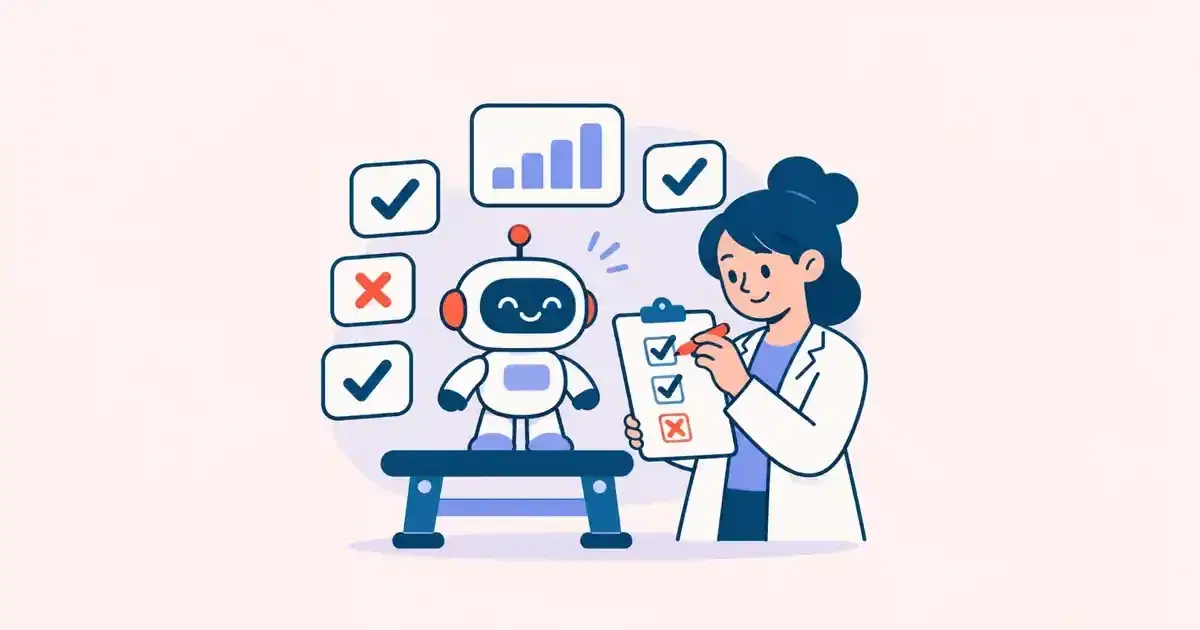
Stop asserting exact outputs and start asserting properties, measured as pass rates over a fixed set of cases. A conventional unit test checks that a function returns one value. An LLM feature returns a different valid answer each time, so the test has to ask whether the answer is well-formed, grounded, safe, and good enough, and it has to ask that across many cases and repeated runs. This article lays out a five-layer framework for doing that in 2027. It is written for engineering leads, QA owners, and CTOs who have an AI feature in the roadmap or already in production and no reliable way to know if the last prompt change made it better or worse.
Observability is common (nearly 89%) but evaluation lags: 52.4% run offline evals on test sets and 37.3% run online evals (LangChain, State of Agent Engineering, 2026)
In a January 2026 study, a generic rule appended to a RAG prompt cut one model's citation and compliance score from 26 of 30 cases to 9 of 30 (Commey, arXiv:2601.22025, revised June 2026)
Treat every prompt, model, and retrieval change as a potential regression, and gate it on a task-specific test suite
Our recommended stack: contract checks, a golden dataset, a calibrated judge, adversarial tests, and production evals feeding back into the dataset
Why Traditional Testing Breaks Down for LLM Features
Three properties of language models defeat the usual test habits. Outputs are probabilistic, so the same input can produce different valid text. Outputs are semantically variable, so two correct answers can share no words. And behavior is sensitive to changes you did not make: a provider updates a model, a retrieval index is refreshed, or someone edits a system prompt. A 2026 technical report on LLM application evaluation describes the same problem, noting that outputs are "probabilistic, semantically variable, and sensitive to prompt and model changes" (Commey, arXiv:2601.22025, 2026).
The result is that many teams ship on instinct. A 2026 interview study of nineteen practitioners found evaluation practices that ranged from informal "vibe checks" to organizational meta-work, and identified what the authors call a results-actionability gap: teams gather evaluation data but cannot turn it into concrete improvements (, January 2026). That is a small qualitative sample, so treat it as a pattern worth recognizing, not a market statistic.
Frequently Asked Questions (FAQ)
Yes, but test properties, not exact strings. Use deterministic checks for format, schema, tool calls and citations, then measure quality as a pass rate over a fixed set of cases. Run each case several times, because the same input can pass once and fail the next time.
Let's connect and create something amazing together!
Got an idea or project in mind? Whether it's custom software, a dedicated dev team, or help with digital transformation, we're here for it. Reach out—we'll bring your vision to life.
Contact us
Prefer to speak directly? You’ll find our address, email, and contact details right here.
Office Location
Block A1 Third Floor, Rathinam TechZone, SEZ Campus Pollachi Main Road, Eachanari, Coimbatore, Tamil Nadu 641021, India
Teams can see what their agents do far more often than they can score it (LangChain, State of Agent Engineering). LangChain is an AI tooling vendor and the survey is self-reported, so read the gap, not the exact decimals.
What Does a Practical LLM Testing Framework Look Like?
Use five layers, each catching a different class of failure, ordered from cheapest and most deterministic to most expensive and most realistic. This is our working framework, assembled from our own delivery practice and the research cited here. It is not a published standard.
Layer
What it checks
Method
Runs when
1. Contract checks
Format, schema, required fields, tool-call arguments, length, banned content
Prompt injection, jailbreaks, data leakage, out-of-scope requests
Attack suite, plus manual red-teaming
Before release and on a schedule
5. Production evals
Real-traffic quality and drift
Sampled online scoring, trace review
Continuously
Layer 1: What Should Deterministic Contract Checks Cover?
Check everything that has a right answer in code, and do it without a model. If the feature must return JSON, validate the schema. If it must call a tool, assert the tool name and argument types. If the answer must cite a source from the retrieved set, verify the citation exists in that set. Add length limits and a blocklist for strings that must never appear, such as internal system prompt text or another customer's identifiers.
These checks are fast, free, and never flaky, so they should run on every commit and fail the build. They also give you the first honest number: what share of outputs are even well-formed. Run on a new feature, they often surface malformed outputs you did not expect.
Layer 2: How Do You Build a Golden Dataset?
Start with 30 to 50 real inputs and grow from there. The 2026 MVES study used 30 cases per suite and still exposed large swings between prompt variants (Commey, arXiv:2601.22025, 2026), which shows that a small, task-specific set can be enough to catch a regression. Sample from real user requests or support tickets when you can. Cover the common path, the edge cases, the cases you have already seen fail, and a few inputs that should be refused.
For each case, store the input, any required context, and the property you expect: "answer cites document 3", "refuses and offers a human handoff", "returns a valid refund object". Avoid storing one reference sentence as the answer unless the task truly has one. Score each case pass or fail, then report the pass rate for the suite.
Because outputs vary, run each case several times and report the pass rate, not a single result. A case that passes four runs out of five is telling you something a single green check hides. Set a threshold per suite and block the change if the rate drops below it. The threshold is a product decision: a refund-handling flow deserves a stricter bar than a brainstorming helper.
Why Do Prompt Changes Need Their Own Regression Gate?
Because a change that sounds like an improvement can make a task worse. In the Commey study, stronger output-contract prompts improved strict extraction for both models tested, while generic rules added to a RAG prompt lowered citation and content-compliance scores. The largest drop was for Qwen 2.5 on RAG, from 26 of 30 cases to 9 of 30, when generic rules were appended to the user prompt (Commey, arXiv:2601.22025, 2026). The setup was small local models and 30 cases per suite, so do not generalize the size of the drop to frontier models. The lesson that does carry over is that the direction of a change is not knowable in advance. Treat prompt edits, model upgrades, and retrieval changes as potential regressions and run the suite every time. Weak data foundations make this harder, as we cover in why legacy systems block AI adoption.
Layer 3: How Do You Use an LLM as a Judge Without Fooling Yourself?
Use a model to score what code cannot, and calibrate that judge against humans before you trust it. Write a narrow rubric with a few concrete criteria ("Does the answer use only facts from the provided context?"), ask for a score plus a short reason, and use a stronger or different model than the one under test when you can.
Then validate the judge itself. Have two people label 50 to 100 outputs, measure how often the judge agrees with them, and record where it disagrees. Re-check after you change the judge prompt or model. Common failure modes to look for are a preference for longer answers, a preference for the first of two options shown, and a tendency to favor text written by the same model family. Randomize order when comparing two answers, and keep human spot checks in the loop for high-stakes categories. We have not found a shortcut here: an uncalibrated judge produces confident numbers that measure the judge.
Layer 4: What Adversarial Tests Does an LLM Feature Need?
Test the ways a hostile or careless user can push the feature off task. Build a suite covering prompt injection (instructions hidden in user input or retrieved documents), attempts to extract the system prompt, requests outside the feature's scope, and attempts to pull other users' data. If the feature can call tools, test what happens when injected text asks it to use one.
Run the suite before every release and add every real incident to it. Pair it with periodic manual red-teaming, because scripted attacks only find the attacks you thought of. For features that touch money, accounts, or personal data, we recommend treating a failed adversarial case as a release blocker, not a metric to trend.
Layer 5: How Do You Evaluate an LLM Feature in Production?
Sample live traffic, score it, and feed the failures back into your golden dataset. LangChain's survey found offline evals at 52.4% adoption and online evals at 37.3% (LangChain, State of Agent Engineering, 2026), so production scoring is where most teams still have a gap. Start with cheap signals: contract-check pass rate on live outputs, refusal rate, user thumbs-down, escalation-to-human rate, and a sampled judge score on a few percent of traffic. Alert on a drop against your own baseline.
Then close the loop. Review a weekly sample of traces, label the bad ones, and add them to the golden set with the expected property. This is what keeps the dataset representative as users change, and it is the step that turns observability into improvement. The 2026 interview study's results-actionability gap describes teams that collect data and stall at exactly this point.
Wiring the Layers Into CI/CD and Release
Run the cheap layers on every commit and the expensive ones on a schedule or before release. A workable split for 2027:
Every pull request: layer 1 contract checks plus a fast slice of the golden set, with a pass-rate threshold that blocks the merge.
Nightly: the full golden set with repeated runs, plus the calibrated judge, with results trended over time.
Before release: the adversarial suite, a human review of judge disagreements, and a sign-off on the change log of prompt, model, and retrieval versions.
After release: sampled production evals, alerts against baseline, and the weekly trace review.
If your pipeline also uses agents, see which steps to automate and which to keep human in our guide to AI agents in CI/CD. Version everything that can change behavior: the prompt, the model name and version, retrieval settings, and tool definitions. Pin the model version where your provider allows it, and treat a provider-announced model update as a change that triggers the full suite. Record the cost and latency per run as well, since a change that holds quality but doubles the bill is still a regression.
Common Mistakes Teams Make When Testing LLM Applications
The same few mistakes recur. Teams test with a handful of hand-picked demo prompts and call it done. They assert one exact reference sentence and then loosen the check until it passes everything. They trust an uncalibrated judge. They run each case once and read a single green check as proof. They never add production failures back to the test set, so the dataset slowly stops resembling real traffic. And they skip adversarial tests because the feature "only answers questions", until a retrieved document contains instructions. Each of these is cheap to fix once named, and the framework above is mostly a way of making them hard to skip.
Where to Start If You Have Nothing Today
Start small and sequence it. In week one, write the contract checks and 30 golden cases from real inputs, and run them locally. In week two, put them in CI with a threshold and add repeated runs. In week three, add a rubric and a judge, and label 50 outputs by hand to calibrate it. In week four, add the adversarial suite and sample production traffic. This timeline is our estimate for a single feature with one team, and it will stretch for agents with many tools. The point is that a useful safety net takes weeks, not quarters. For the wider plan around AI features, see our AI strategy for software companies guide.
The Bottom Line
For 2027, treat an LLM feature like any other production system: it needs tests, but the tests have to match how it fails. Assert properties instead of strings, measure pass rates over repeated runs, calibrate any model that grades another model, attack your own feature before users do, and feed production failures back into the suite. The survey data shows most teams can already observe their AI features and fewer can score them, so the evaluation layer is where a disciplined team gets ahead.
To set up a test and evaluation stack for your own AI features, contact TartLabs and we will review it with you.
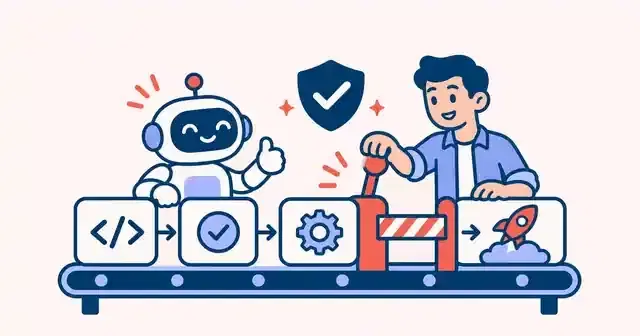
Let AI agents triage, summarize and propose in your pipeline, but keep deploys, secrets and merges human. A 2027 split, with 2026 survey and security data.