

Written by Gowtham Raj, Director at TartLabs, who leads custom software and modernization engagements for manufacturing, logistics, and enterprise clients.
The Short Answer
Four obstacles in legacy systems hold back AI: trapped data; no reliable route through which a model can read or write; an inability to demonstrate that changes are safe; and platforms unsuited to modern workloads. Address them broadly in that sequence, introducing security reviews and data-quality work as you go. In a September 2026 survey, 84% of CIOs and CTOs reported cancelling an AI pilot or project because of constraints in their legacy systems. Becoming unblocked seldom requires rewriting everything. What it does require is access to the data, several dependable interfaces, and a testing safety net for any process the AI touches.
Key Takeaways
- Legacy constraints have prompted 84% of CIOs and CTOs to cancel an AI pilot or project (GFT Technologies and Wakefield Research; 945 people surveyed in August 2026).
- Legacy or still-developing infrastructure remains in use at 65% of enterprises; just 29% report that their infrastructure scales with business needs (Tata Communications and Bloomberg Media Studios, 501 executives).
- Gartner forecasts that, through 2026, 60% of projects without AI-ready data will be dropped; it also found that 63% of organisations either do not have suitable data practices or do not know whether they do.
- First priorities: enable access to data, establish its reliability, make operations testable, secure them, and only then migrate the platform. That sequence is our view, not an established standard.
- You do not have to pay for a complete rewrite to begin. For most initial AI applications, dependable wrappers around old systems remove the blockage.
The following sections provide sources for every figure. Advice originating with us carries the label our view.
What the Numbers Say
Although they examine different measures, three current sources reach a similar conclusion. Compare them alongside one another; do not combine their figures.
| Source | Finding | What it measures |
|---|---|---|
| GFT Technologies / Wakefield Research (29 September 2026) | Legacy constraints led 84% of CIOs and CTOs to cancel a pilot or project involving AI | 945 leaders across 19 countries at businesses earning $500M+ in revenue |
| Tata Communications / Bloomberg Media Studios (8 June 2026) | AI is a board priority for 77%, but 65% operate legacy or developing infrastructure; 29% believe it scales | 501 senior executives from companies with revenue of $500M+ |
| Gartner (26 February 2025) | Through 2026, 60% of AI projects that do not have AI-ready data will be discontinued | A forecast supported by a July 2024 poll of data-management leaders |
There are two qualifications. Because GFT provides modernization services and Tata Communications provides network infrastructure, each benefits from this conclusion. In addition, GFT's statistic refers to the cancellation of any pilot rather than the proportion of all AI initiatives that become stuck. Even after allowing for those limitations, independent evidence points in the same direction. It also accords with the pattern outlined next—our interpretation, not a survey result.
How Legacy Systems Block AI
1. The data is locked in
Systems never designed for queries beyond their own user interfaces and overnight reporting hold much of a company's essential information. Records might use proprietary formats, be scattered among contradictory schemas, or be available solely via a batch file that arrives one day behind. Last night's export cannot support a model seeking the status of an order this morning.
Gartner offers a helpful formulation: whether data is AI-ready depends on its actual usability for a particular AI application. That is a more specific requirement than "we have a data warehouse." Its finding of 63% indicates that most organisations have yet to apply this test.
2. There is no clean way in or out
An AI assistant looking up inventory, or an agent modifying a support ticket, must have something it can call. Many older applications provide no such interface. Instead, integrations scrape screens, manipulate databases directly, or exchange files through shared directories. A change to the underlying system can silently break any of these methods, and none gives a model an easy, safe way to operate.
3. Nobody can prove a change is safe
Undocumented business logic lives inside legacy applications. Before an AI capability reads from or writes into one of those workflows, the existing behaviour must be understood well enough to verify it through testing. Where tests are absent, modifications become bets; teams consequently delay the work or abandon it. In our view, this unseen issue explains why numerous pilots go no further than a demonstration.
4. The platform cannot host modern workloads
Repeated API traffic would overload certain systems. Others are confined to a datacentre that cannot reach the GPUs, managed services, or vector databases on which AI functionality depends. The finding from Tata Communications and Bloomberg—that only 29% of enterprises consider their infrastructure capable of scaling with demand—points to a related issue, although that research does not separate capacity for AI workloads.
What to Fix First
The sequence below is our view of how to enable the greatest number of AI applications at the lowest cost. Because it is not an official standard, adapt it to your technology estate.
- Make the data reachable. Start by producing a governed copy, updated close to real time, of precisely the information required by the initial use case. Replicating changes into a contemporary data store is preferable to rebuilding the source system. Limit the work to a single dataset and use case rather than the entire estate.
- Make the data trustworthy. Establish a shared meaning for every field consumed by the AI (what counts as an "active customer"?), identify missing and duplicate records, and name the responsible owner. Gartner's warning about AI-ready data becomes relevant at this stage.
- Put stable interfaces around the legacy core. Place clearly specified APIs—with rate limiting and authentication—around only the operations required by the AI. The implementation behind that boundary can then change without disrupting the AI capability. The available approaches appear in our guide to integrating existing systems with new software.
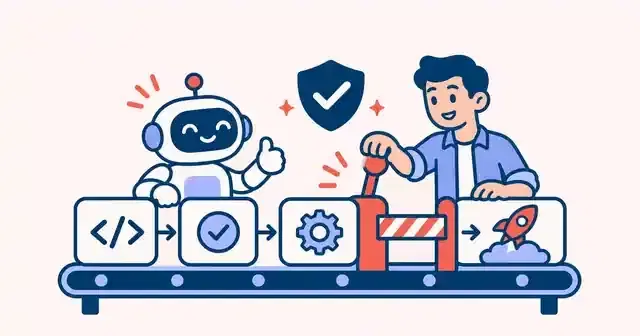
- Build a test safety net around those operations. Before altering the system, turn its present behaviour into automated tests. Teams omit this step most frequently, even though it reduces the cost of everything that follows.
- Secure it. According to GFT, 93% of CIOs and CTOs think that operating AI on legacy infrastructure that has not been modernised will ultimately cause a security crisis across the enterprise. Older applications commonly miss current access controls, identity capabilities, and logging; granting an AI agent extensive access widens that exposure.
- Then move the platform. Wait to re-host or reconstruct the core until tests and interfaces are in place. With a well-defined boundary, decisions about cloud application development become much simpler. For a schedule, consult how long AI-assisted modernization takes.
When a Rewrite Really Is Needed
A wrapper is effective unless the underlying system is itself the obstacle. A more substantial rebuild merits consideration when even a wrapper cannot surface its data, support from the vendor has ended, limited code knowledge turns every minor alteration into weeks of work, or building the interface tier would be costlier than replacing the underlying application. Base that call on findings from a brief assessment, rather than a supplier's presentation.
A Self-Audit You Can Run This Week
For the first AI application you intend to release, answer the following:
- Without exporting it manually, can we supply its required data at the necessary freshness?
- Is a single individual accountable for defining every important field?
- Can the AI invoke an interface, or does the system provide only a user screen and database?
- If the AI makes an incorrect write, can we discover and undo it?
- Is the process's existing behaviour represented in tests before we touch it?
- Can this system cope with ten times the number of calls it handles now?
When at least three responses are "no," the model is not the constraint; the underlying foundation is. For the strategic aspect of that choice, read our AI strategy for software companies guide.
The Bottom Line
Legacy technology almost never prevents AI altogether. Instead, it makes information inaccessible, integration difficult, and modifications untrustworthy. Among the technology executives surveyed by GFT, 84% reported the consequence in cancelled projects; Tata Communications' study, meanwhile, found that only 29% of enterprises believe their infrastructure scales.
Fix the foundation in this order: reachable data, trustworthy data, stable interfaces, a test safety net, security, and only then the platform. Before assigning budget to a model, apply the audit to the first intended use case. For another perspective on your specific obstacle, get in touch, review our AI strategy for software companies guide, or learn how a dedicated team can conduct a tightly scoped assessment while your engineers stay focused on their roadmap. If a rewrite is unnecessary, we will tell you directly.